
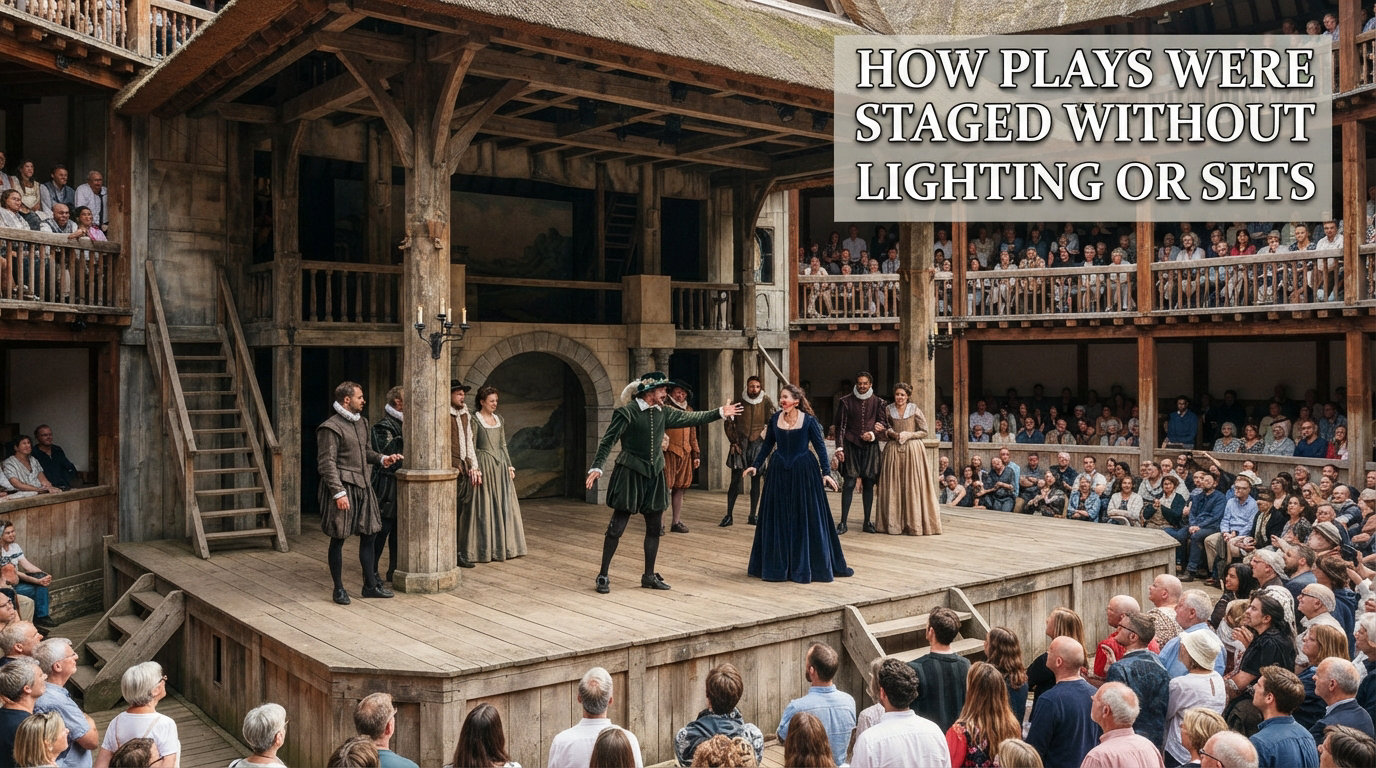
I still remember the first time I watched a performance at Shakespeare’s Globe in London. The afternoon sun lit the wooden stage, the actors wore vivid period costumes, and there was not a single spotlight in sight. That experience sent me down a rabbit hole researching how plays were staged without modern lighting or sets, and the answer turned out to be far more clever than I expected.
Theater before electricity was not a dark art performed in dim rooms. It was a craft built on architecture, daylight, flame, costume, and the active imagination of an audience that stood just a few feet from the actors. In this guide, I walk you through the techniques, tools, and tricks that stage managers, actors, and designers used for nearly two thousand years before the lightbulb changed everything.
Table of Contents
The Ancient Origins: Greek and Roman Amphitheaters
The earliest Western theater depended completely on the sun. Greek tragedies and comedies were performed in massive open-air amphitheaters like the Theatre of Dionysus in Athens, built into hillsides so thousands of spectators could see the action at once.
The Greek theatron, or seeing place, was a semicircle of stone seats that climbed up a hillside. A flat dancing floor called the orchestra sat at the bottom, and behind it stood the skene, a small building that served as a dressing room and a backdrop for the action.
Performances started at dawn and ran through the heat of the day. There were no curtains, no wing space, and no scenery in the modern sense. Actors used oversized masks, flowing robes, and platform boots called kothornoi to make themselves visible from the back rows.
Roman theaters built on the Greek model but added stage machinery. The deus ex machina was a crane that lowered gods onto the stage, while a rolling platform called the cyclose revealed interior scenes. Even so, the staging relied on natural light, simple props, and the audience’s familiarity with the story.
Medieval Mystery and Miracle Plays on Wheels
When the Roman Empire fell, theatrical traditions shifted into the hands of the church. Mystery plays and miracle plays retold Bible stories, and they were performed on traveling wooden carts called pageant wagons.
Each wagon was a miniature stage on wheels. A typical wagon had two levels, with a small platform above that represented heaven and a lower area for the earthly scenes. The whole structure could be hauled by horses from one town square to the next.
One wagon might stage Adam and Eve, the next could perform the Crucifixion, and the troupe would roll from town square to town square throughout the day. Performances happened outdoors in market streets, so daylight was once again the only option.
Costumes were the primary visual storytelling tool. Actors playing God wore gold cloth, devils wore furred hides, and Herod was dressed in elaborate robes that signaled his vanity. Theatrical companies kept their best costumes in town and rented them out, which is why props could be more valuable than scripts.
Why Open-Air Theaters Depended on Daylight
Shakespeare’s plays had to be performed in daylight because the most popular venues, including the Globe, the Rose, and the Swan, were open to the sky. There were no walls, no roof over the stage, and no windows to control.
Indoor venues like the Blackfriars Playhouse used candles, but even there the lighting was so dim that audiences could not have read programs. Daylight was simply brighter, safer, and more reliable than any flame-based alternative.
Plays also began in the early afternoon, usually around 2 or 3 p.m., and ran for about two hours. The tighter schedule meant audiences saw a complete story in one visit, and the natural light shift from afternoon to early evening gave performances a natural arc without anyone touching a dimmer switch.
The groundlings, who paid a single penny to stand in the yard around the stage, often suffered through sun, rain, and cold. A sudden cloud cover could dim the stage enough to halt a scene, which is why contemporary accounts sometimes mention pauses for weather rather than for dramatic effect.
Inside the Globe Theatre: Architecture and Staging
The Globe Theatre was built around the limitations of pre-electric lighting. The stage was a large rectangular platform that thrust out into the yard, so spectators surrounded actors on three sides and saw every gesture up close.
According to the analysis at BBC Bitesize, the stage was partly covered by a painted roof called the Heavens, which hid the fly system used to lower actors playing gods and spirits. Tubs of burning beacons sometimes sat on the Heavens to signal a scene taking place at night or in the underworld.
The backdrop of the stage was a tall facade called the frons scenica, which featured two doors for entrances and a curtained alcove in the middle that could be revealed as a discovery space. A pillar in the center of the upper gallery served as a property post, and a sloping roof over the stage protected the main playing area from most weather.
Behind the stage stood the tiring house, a multi-level structure that served as a dressing room, props storage, and a viewing gallery for nobility. The upper level often represented battlements, balconies, or city walls, which meant Romeo could climb to Juliet’s window without any scenery change at all.
Candle and Oil Lamp Lighting Technology
The candle was the workhorse of early indoor theater. Tallow candles made from animal fat gave a yellow, smoky flame, and a single chandelier above the Blackfriars stage might hold dozens of them at once.
According to the Royal Shakespeare Company, a young stagehand called a snuff boy sat in the rafters with scissors and a long forked stick. His job was to trim the burned wicks so the flames stayed bright, which is why the role appears in many apprentice contracts of the period.
Beeswax candles were the luxury option. They burned cleaner and brighter than tallow, but they cost several times more, so only the wealthiest theater companies could afford to fill their chandeliers with them.
Oil lamps and reflective metal dishes improved on the candle. The Argand burner, invented in the 1780s, used a glass chimney and a tubular wick to burn cleaner and brighter, but for most of Shakespeare’s era the simple candle and the snuff boy were the entire lighting team.
Indoor Innovations at the Blackfriars Playhouse
The Blackfriars Playhouse flipped the lighting problem on its head. Built inside a former Dominican friary, it was a smaller, enclosed venue with a private candlelit auditorium and a higher ticket price.
As RSC materials explain, the indoor space encouraged a more intimate style of acting. With crowds closer to the stage and fewer than a hundred candles overhead, audiences could actually see facial expressions and hear quiet dialogue.
Playwrights took advantage of the new intimacy. Subplots, whispered asides, and emotional monologues became more common in indoor plays, because the audience could finally catch every word. This is one of the reasons Shakespeare’s later Jacobean works feel different from his early outdoor productions.
The Blackfriars venue also introduced a different relationship with the audience. Galleries ringed three sides of the stage, so patrons seated above could look down on the actors and on each other. The indoor setting created a more conversational atmosphere, which is why private boxes became a status symbol for wealthy Londoners.
Inigo Jones and the Birth of Stage Design
Inigo Jones changed the rules in the early 1600s. Working with playwright Ben Jonson, he designed elaborate court masques featuring painted perspective backdrops, moveable scenery, and dyed silk lighting filters.
His sets used flat wings that slid into grooves on the stage floor, a direct ancestor of the modern flat and the wagon stage. Jones also experimented with colored liquids in glass containers to tint candlelight, an early form of the gel that lighting designers still use today.
Jones also introduced the proscenium arch to England, framing the stage like a picture. His work at the Banqueting House in Whitehall set the template for centuries of indoor theater design, even though his ideas did not reach the public playhouses until well after his death.
Minimal Sets and the Power of Audience Imagination
The most surprising lesson I learned while researching this topic is that actors did not need scenery to set a scene. Verbal cues did the heavy lifting, and a line like “this is the forest of Arden” was enough to plant an entire forest in the audience’s mind.
Properties carried symbolic weight rather than realism. A single throne represented a kingdom, a wooden coffin stood in for a deathbed, and a basket of props backstage could become anything an actor named aloud. Modern Globe productions still use this stripped-down approach, and audiences respond to it surprisingly well.
Special effects came from the theater’s physical structure. A trapdoor in the stage floor opened for ghosts and emerging devils, while the Heavens above served as the source of thunder sheets and anything that needed to fall from the sky.
Music and sound filled the gaps that scenery could not. Trumpets, drums, and recorders cued entrances, signalled battle, and marked the mood of a scene. Without recorded effects, every sound was performed live, which gave productions a flexibility that modern productions sometimes struggle to match.
How Actors Built Atmosphere Without Lighting
Without spotlights, an actor’s body became the lighting effect. Strong blocking, oversized gestures, and projected voices meant that a performer could command attention even in the back row of the yard.
Costume changes happened in view of the audience. A quick swap signaled a character shift, and the tiring house balcony let one actor become two different characters in the same scene. Sound was equally important: a clap of thunder came from a sheet of metal backstage, and the few stage directions that survive in scripts were often prompts for a sound cue rather than a lighting cue.
Forum discussions on r/acting and r/shakespeare often mention how modern performers visiting the reconstructed Globe find themselves adjusting to the open-air stage. Without the comfort of a darkened auditorium, every actor had to project outward and trust the audience to do the rest, a skill that defined the entire Elizabethan profession.
Audience interaction was also part of the staging. Groundlings shouted reactions, vendors sold ale and fruit, and pickpockets worked the crowd. The play did not stop for any of it, which meant actors had to compete with the noise and keep the story moving forward. That constant pressure shaped the loud, clear, and rhythmic style of Elizabethan verse.
FAQs
How were plays staged in Shakespeare’s time?
Plays were staged on open-air thrust stages surrounded by audiences on three sides. Performances began in the afternoon, relied on natural daylight, and used minimal scenery. The stage was framed by a tiring house at the back and a painted roof called the Heavens overhead. Actors used costume, props, and language to set each scene.
Why did Shakespeare’s plays have to be performed in daylight?
The most popular venues, including the Globe and the Rose, were open to the sky with no roof over the stage. Candles were too dim and too smoky to light a full outdoor performance, so afternoon daylight was the only practical option. Indoor venues like Blackfriars used candles, but even there the lighting was limited.
How did actors create night scenes without lighting?
Night scenes were signaled through language, not lighting. Lines like ‘ere the bat hath flown’ told the audience the time of day, and tubs of burning beacons on the Heavens suggested a darker mood. Actors also lowered their voices and slowed their movement to convey the feel of night.
Why Understanding Old Staging Matters Today
Learning how plays were staged without modern lighting or sets changes how we read Shakespeare’s writing. Lines that feel like filler today were once practical cues that set scenes, cued sound effects, or told the audience where to look.
Modern productions at reconstructed venues like Shakespeare’s Globe and the Blackfriars Playhouse prove that the old techniques still work. Audiences laugh, cry, and gasp without a single spotlight, which says a lot about the power of language and a well-built stage.
If you want to explore this further, pick up a copy of any modern critical edition of Shakespeare and read the stage directions aloud. Then visit a reconstructed playhouse if you can. The experience of seeing a daytime performance on a thrust stage is the closest thing we have to a time machine, and it makes the old scripts come alive in a way no film adaptation ever will.