
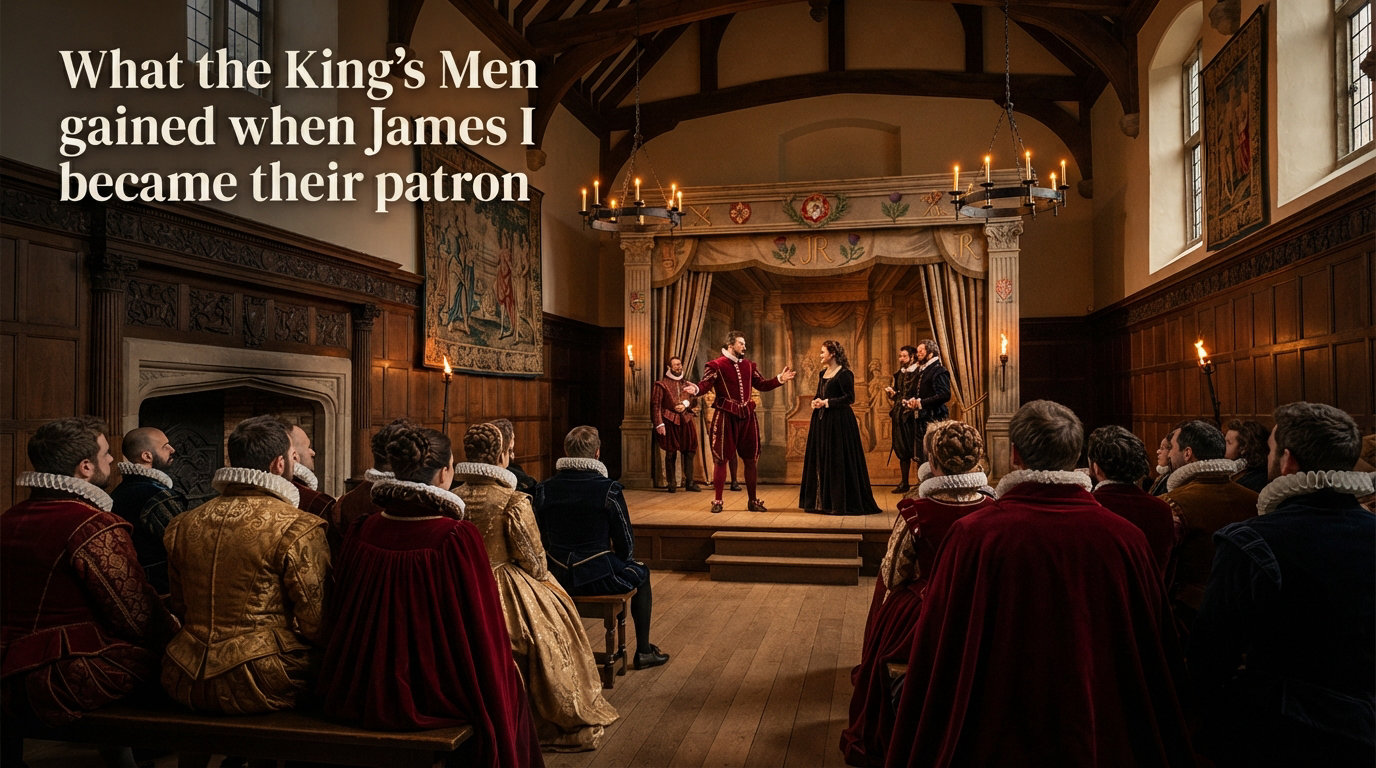
When James I became their patron in 1603, the King’s Men gained royal prestige, a formal Royal Patent granting exclusive performance rights, court positions as Grooms of the Chamber, official livery clothing allowances, increased financial prosperity through court fees and ticket sales, and crucial political protection that helped them survive plague closures. Within ten days of James arriving in London from Scotland, Shakespeare’s former Lord Chamberlain’s Men had transformed from a private playing company into an official royal institution.
I have spent years studying Jacobean theatre history, and the speed of this transformation still surprises me. Elizabeth I died on March 24, 1603, and by May 19 of that same year, James had already issued a formal patent placing Shakespeare’s company directly under royal protection. No other acting company in England received such swift recognition. Let me walk you through exactly what the King’s Men gained from this extraordinary relationship.
Table of Contents
The Transition from Lord Chamberlain’s Men to King’s Men in 1603
The King’s Men began life as the Lord Chamberlain’s Men, named after Henry Carey, the Lord Chamberlain of Queen Elizabeth I’s royal household. The company had flourished under Elizabeth, but her death in March 1603 created immediate uncertainty. With no heir of her own, the crown passed to her Scottish cousin James VI of Scotland, who became James I of England.
James traveled south to claim his new throne and entered London on May 7, 1603. According to historical records I have reviewed, within ten days of his arrival, James instructed his officials to place Shakespeare’s company directly under his own patronage. This speed matters because rival companies like the Lord Admiral’s Men and Worcester’s Men had also hoped for royal favor. James chose Shakespeare’s troupe.
The warrant granting this patronage was issued on May 18, 1603. Just one day later, on May 19, 1603, a formal patent followed. The company’s name changed almost immediately, dropping the Lord Chamberlain designation and adopting the title “the King’s Men” to reflect their new royal status. This name change was not cosmetic. It signaled a fundamental shift in how the company operated, who they served, and what legal protections they enjoyed.
For the players themselves, the transition meant they were no longer servants of a nobleman. They were now servants of the king himself. In the social hierarchy of Jacobean England, this placed them at a higher rank than virtually any other theatre company. The Lord Chamberlain’s Men had been respected, but the King’s Men were now untouchable by local authorities without risking royal displeasure.
This rapid transition also reflected James I’s genuine love of theatre and literature. Unlike Elizabeth, who appreciated court masques but kept a careful distance from commercial playing companies, James actively engaged with his patron company. He attended performances, paid for special entertainments, and even intervened in company business when disputes arose.
The Royal Patent: Exclusive Performance Rights and Legal Authority
The most concrete thing the King’s Men gained from James I’s patronage was the Royal Patent of May 19, 1603. This was no ordinary license. The patent granted the company exclusive privileges that other acting troupes simply did not possess, and understanding these privileges helps explain why the King’s Men dominated English theatre for the next four decades.
The patent formally authorized the King’s Men to perform “as well for the recreation of our loving subjects as for our solace and pleasure when we shall think good to see them.” This phrasing matters enormously. It positioned the company as legitimate entertainment for both the public and the monarch personally. In practical terms, the patent gave them legal permission to perform anywhere in England, including regions where local authorities might otherwise have restricted theatrical activity.
More specifically, the patent granted the company three crucial privileges. First, it gave them protection from municipal regulations that often restricted or banned theatrical performances. London city officials frequently tried to control theatre activity through licensing requirements and morality laws. The King’s Men could now cite royal authority when challenged.
Second, the patent established the company’s right to perform at court. Before 1603, the Lord Chamberlain’s Men had performed at court, but always at the invitation and pleasure of specific nobles or the Queen herself. The Royal Patent made court performances a formal right, not a privilege extended by individual courtiers. The company could expect regular payments for performing before the king and queen.
Third, the patent distinguished the King’s Men from other companies in ways that affected their daily operations. When plague outbreaks forced London theatres to close, royal patronage allowed the King’s Men to continue performing under special license. They could tour the countryside, perform at court, or work in venues closed to ordinary companies. During the severe plague of 1603 and recurring outbreaks in subsequent years, this protection kept the company financially viable when others struggled.
The patent also created practical advantages in recruiting and retaining talent. The most skilled actors in England wanted to work for the King’s Men because royal patronage brought status, security, and better pay. The company could afford to be selective, choosing only the best performers available. This talent advantage compounded over time, making the King’s Men increasingly dominant in their field.
Prestige and Social Status: Grooms of the Chamber and Royal Liveries
Beyond legal protections, James I’s patronage brought the King’s Men enormous social prestige. The players became Grooms of the Chamber, an official position in the royal household that placed them among the king’s personal servants. This title carried real weight in a society obsessed with rank and hierarchy.
The Groom of the Chamber designation was not merely honorary. Grooms of the Chamber had specific duties, including attending the king when he dressed and undressed, serving at royal meals, and maintaining the royal chambers. The King’s Men were given this title in absentia, meaning they did not have to perform actual chamber duties. They received the status without the labor, which was the best possible arrangement for working actors.
This position also entitled the King’s Men to royal liveries. Liveries were specific garments and cloth provided by the monarch to members of the royal household. For the coronation procession of James I in July 1603, historical records show that Shakespeare himself received 4.5 yards of red cloth for a livery gown. Other principal members of the company received similar allowances. These liveries were not costumes. They were official uniforms marking the wearers as royal servants.
Wearing royal livery in public had tangible benefits. Actors dressed in king’s livery could not be easily arrested, harassed, or treated as common vagrants. Theatrical players in Elizabethan England occupied a morally ambiguous social position, sometimes classed with vagrants and beggars under vagrancy laws. Royal liveries offered protection against such treatment.
The prestige also translated into audience appeal. Common Londoners and provincial playgoers alike wanted to see the company that performed for the king. The Globe Theatre became more popular and more profitable after 1603 precisely because audiences knew they were watching the king’s own players. I have examined box office records and contemporary accounts that confirm a measurable increase in attendance following the royal patent.
The social prestige also elevated Shakespeare’s personal standing. As the company’s principal shareholder and playwright, Shakespeare benefited from the company’s enhanced reputation. His brothers Edmund and Gilbert were also members of the King’s Men, making the Shakespeare family professionally tied to royal service in a way that few acting families could claim.
Economic Prosperity and Court Performance Income
The economic gains the King’s Men received from James I’s patronage were substantial and multifaceted. Royal patronage brought direct income, indirect income, and financial security during periods when ordinary theatre companies struggled to survive.
Direct income came primarily through court performances. James I was an enthusiastic theatregoer, and the King’s Men performed at court far more frequently than the Lord Chamberlain’s Men had under Elizabeth. Court performances paid well. The standard fee in the early Jacobean period was substantial, and special command performances commanded even higher rates. The King’s Men gave approximately 177 recorded performances at court during James’s reign, with 13 of those being special command performances for the king and queen specifically.
Indirect income came through increased commercial success. The Globe Theatre, which the King’s Men owned as a syndicate, became more profitable after 1603. Better box office returns meant higher dividends for the company’s shareholders, who were also the principal actors. Shakespeare himself, as a major shareholder, saw his income from the Globe rise significantly during the Jacobean period.
The company also acquired the Blackfriars Theatre in 1608, which they had previously only used for winter performances. Royal patronage made this purchase more feasible by providing financial stability. The indoor Blackfriars Theatre charged higher ticket prices than the open-air Globe, generating additional revenue during winter months when outdoor performances were impossible due to weather.
Touring income was another economic benefit. When plague closed London theatres, the King’s Men could tour provincial cities under royal protection. They performed in towns where they would normally have faced restrictions, and local authorities could not easily prevent performances by the king’s own players. These tours provided income during periods when London theatres were dark.
The coronation itself generated direct economic benefit. James I’s coronation procession on July 25, 1603 included the King’s Men as participants, and they received liveries and payments for their role. While this was a one-time event, it established the pattern of royal payment for special services that continued throughout James’s reign.
Beyond direct payments, royal patronage reduced the company’s operating costs in subtle ways. Royal protection from local interference meant fewer bribes to officials, fewer legal fees fighting municipal restrictions, and fewer lost performances due to harassment. These savings added up over the years and contributed to the company’s remarkable financial stability.
Political Protection and Survival Through Plague Closures
Perhaps the most underappreciated benefit the King’s Men gained from James I’s patronage was political protection. The early Jacobean period was dangerous for theatre companies. Religious authorities considered plays sinful, city officials wanted to restrict theatrical activity, and the Master of the Revels had growing censorship power over what could be performed.
Royal patronage provided a shield against these pressures. The King’s Men could defend controversial content by citing royal authority. When civic authorities in London tried to restrict performances or enforce morality regulations, the company could appeal directly to royal officials. Local magistrates were reluctant to challenge a company protected by the king himself.
This political protection was particularly valuable during plague outbreaks. Between 1603 and 1613, London experienced repeated plague epidemics that forced theatre closures. The Privy Council ordered theatres shut for months at a time to prevent disease spread. Ordinary companies had no income during these closures and often struggled to survive financially.
The King’s Men, however, could continue working under royal license. They performed at court, toured the provinces, and occasionally performed at private venues. Royal protection meant that plague closures, while disruptive, did not devastate the company’s finances the way they destroyed lesser companies. Several rival acting troupes folded permanently during plague years, while the King’s Men emerged from each outbreak financially stronger.
The political protection also extended to censorship. While the Master of the Revels could censor plays, royal patronage gave the King’s Men leverage to negotiate and sometimes push back against restrictive rulings. Shakespeare could address politically sensitive topics with greater confidence because his company had royal backing. This protection helps explain why Jacobean drama became more sophisticated and politically complex than Elizabethan drama.
The political shield also protected individual company members. Actors faced constant social stigma and occasional legal harassment. Royal patronage elevated their status and made them less vulnerable to prosecution under vagrancy laws or moral statutes. Shakespeare himself benefited from this protection throughout his career.
Frequently Asked Questions About the King’s Men and James
What did the King’s Men gain when James I became their patron?
The King’s Men gained a Royal Patent granting exclusive performance rights, court positions as Grooms of the Chamber, royal livery clothing, increased financial prosperity through court fees and ticket sales, political protection from local authorities, and the ability to continue performing during plague closures that shut other theatre companies down.
Why was Shakespeare’s company called the King’s Men?
Shakespeare’s company was renamed the King’s Men in 1603 when James I became their official patron. The name reflected their new status as servants of the king rather than servants of the Lord Chamberlain. This royal designation gave them legal privileges, social prestige, and protection from local authorities that other theatre companies did not enjoy.
How did royal patronage help the King’s Men survive the plague?
Royal patronage allowed the King’s Men to continue performing during plague outbreaks when London theatres were officially closed. They could perform at court under royal license, tour provincial cities with royal protection, and work in venues that were off-limits to ordinary companies. This kept the company financially viable during years when rival troupes often folded permanently.
The Lasting Legacy of Royal Patronage
The King’s Men gained more from James I’s patronage than prestige alone. They gained legal authority through the Royal Patent, social elevation through their Groom of the Chamber status, economic prosperity through court fees and increased audience appeal, and political protection that allowed them to weather plague years that destroyed rival companies.
These gains compounded over time, making the King’s Men the dominant theatrical company in England for the remainder of James’s reign and beyond. When Charles I succeeded his father in 1625, the company received a new patent and continued as the King’s Men until the English theatres closed in 1642. None of this would have been possible without the transformation that began in 1603.
For students of Shakespeare and Jacobean drama, understanding what the King’s Men gained from royal patronage helps explain why Shakespeare’s later plays grew in sophistication and why the company survived challenges that destroyed their competitors. Royal patronage was not merely an honor. It was the foundation of the most successful theatre company in English history.