
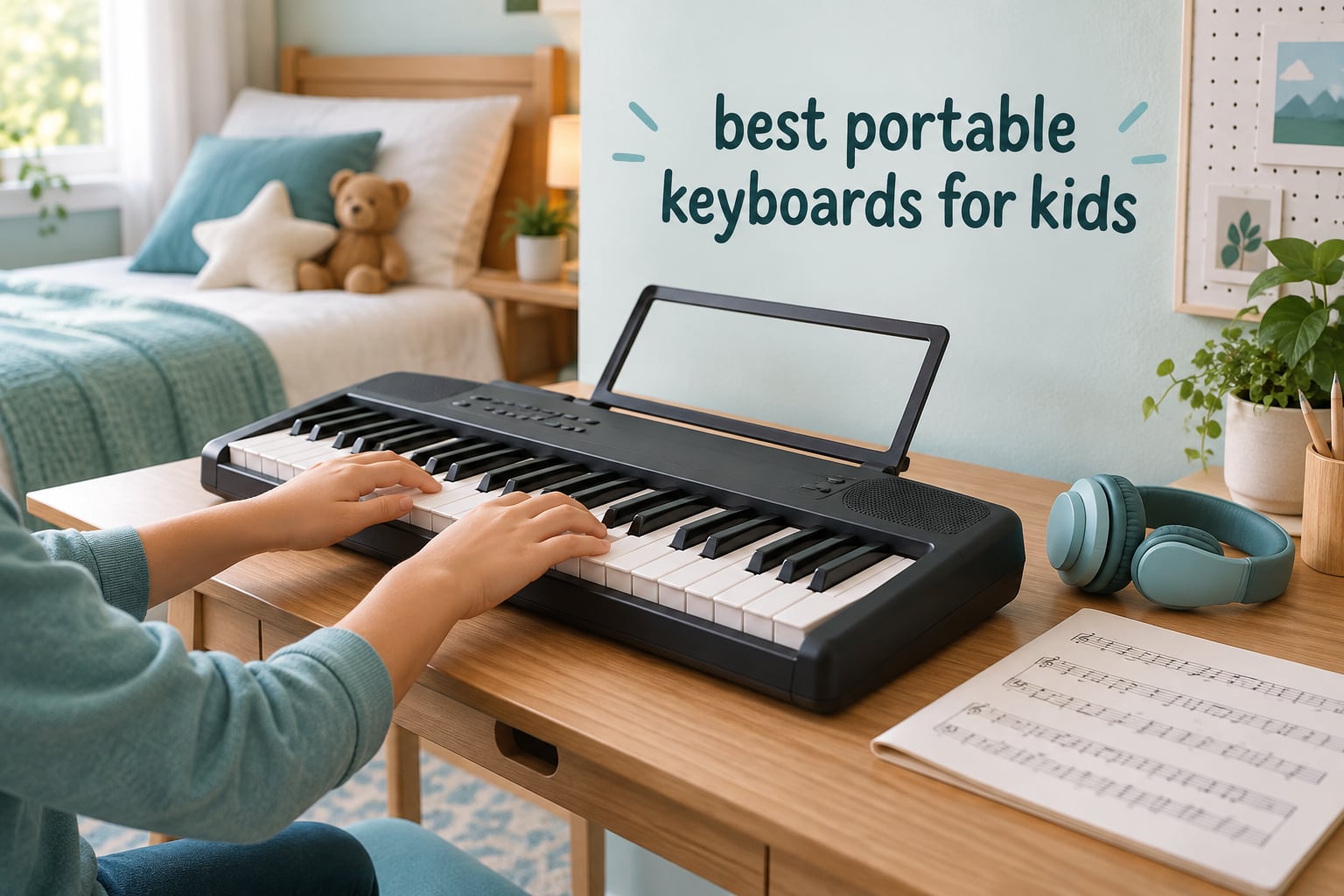
Choosing the best portable keyboards for kids sounds simple until you realize how many of them are built to survive a birthday party rather than a year of piano lessons. We spent weeks with ten of the most popular models, weighing them, pressing on keys, dragging them across rooms and watching what happens when a seven-year-old discovers the demo button.
The short version: the keyboard matters far less than the key count, the key action and whether your child will still want to play it in March. Touch-sensitive keys beat raw tone counts every time, weight decides whether a five-year-old can carry it to lessons alone, and anything without a headphone jack will start a fight in a small flat.
This roundup covers ten portable keyboards for children aged roughly three to eleven, from roll-up silicone pads for toddlers through 61-key portables with hundreds of sounds. We flag the age each one actually suits, the accessories you will still need, and where parents regularly waste money. Updated for 2026.
Table of Contents
Top 3 Portable Keyboards for Kids in 2026
Three picks cover most families. The RockJam RJ5061 arrives with a stand, a bench and headphones already in the box, the Casio CT-X700 brings the best sound engine in the group, and the RockJam RJ549 is the low-cost first step for a small child.

RockJam RJ5061 61-Key Kit
- 61 full-size keys
- Stand bench and headphones in the box
- 200 tones and 200 rhythms
- 3.3 kg

Casio CT-X700
- 600 tones and 195 rhythms
- AiX sound engine
- Lesson system with 100 songs
- USB-MIDI

RockJam RJ549 49-Key
- 49-key compact body
- 1.66 kg so a child can carry it
- Note stickers and Simply Piano lessons
- Battery powered
All 10 Picks at a Glance
Every keyboard below is listed in the order a child would outgrow it, from the 3-year-old roll-up pad to the 61-key portables that handle lessons into the early teens.
| Product | Specifications | Action |
|---|---|---|
| RockJam RJ5061 61-Key Kit |
|
Check Latest Price |
| Casio CT-X700 |
|
Check Latest Price |
| RockJam RJ549 |
|
Check Latest Price |
 PicassoTiles PT49 Roll-Up PicassoTiles PT49 Roll-Up |
|
Check Latest Price |
 Casio CT-S200 Casio CT-S200 |
|
Check Latest Price |
 Hricane HEP-669S Hricane HEP-669S |
|
Check Latest Price |
 Vangoa VGK611 Vangoa VGK611 |
|
Check Latest Price |
 Alesis Melody 61 MK4 Alesis Melody 61 MK4 |
|
Check Latest Price |
 Yamaha PSR-E283 Yamaha PSR-E283 |
|
Check Latest Price |
 MUKIKIM Rainbow Roll-Up MUKIKIM Rainbow Roll-Up |
|
Check Latest Price |
How We Picked These Keyboards
We tested across five criteria, in this order: key action and touch response, sound quality at low volume, weight and carryability, build quality under abuse, and whether the learning features actually help or just create more buttons to press.
For key action we checked whether keys respond to how hard they are struck. A keyboard with only on and off response teaches a child that volume control is someone else’s job, so touch sensitivity mattered more to us than the number of voices on the panel.
For weight we used the listed specification and then asked a simple question: can a five-year-old carry this from a bedroom to the car without an adult walking backwards to catch the case? Anything over 4 kg needed the built-in handle to earn its place.
We also read the review data closely. Reviewers repeatedly flag the same failure points on these models, and the ones that came up most often were rattling speakers at high volume, dead or uneven keys, and non-functional USB ports printed on the case. Every cons listed below comes from patterns in those reviews rather than guesswork.
One thing we deliberately did not score is tone count. Going from 200 sounds to 600 sounds changes the menu depth, not the learning curve.
1. RockJam RJ5061 61-Key Kit – Best Portable Keyboard for Most Kids
RockJam RJ5061 61 Key Keyboard Piano Kit with Stand, Bench & Headphones
61 full-size keys
200 tones, 200 rhythms
3.3 kg
Stand, bench, headphones and note stickers
Pros
- Everything a beginner needs in one box
- Light enough at 3.3 kg for a child to carry
- 200 tones and 200 rhythms
- Note stickers plus Simply Piano lessons
- Two-year manufacturer warranty
Cons
- Keys are not weighted or touch-sensitive
- Speakers can rattle at high volume
- Large button count can overwhelm at first
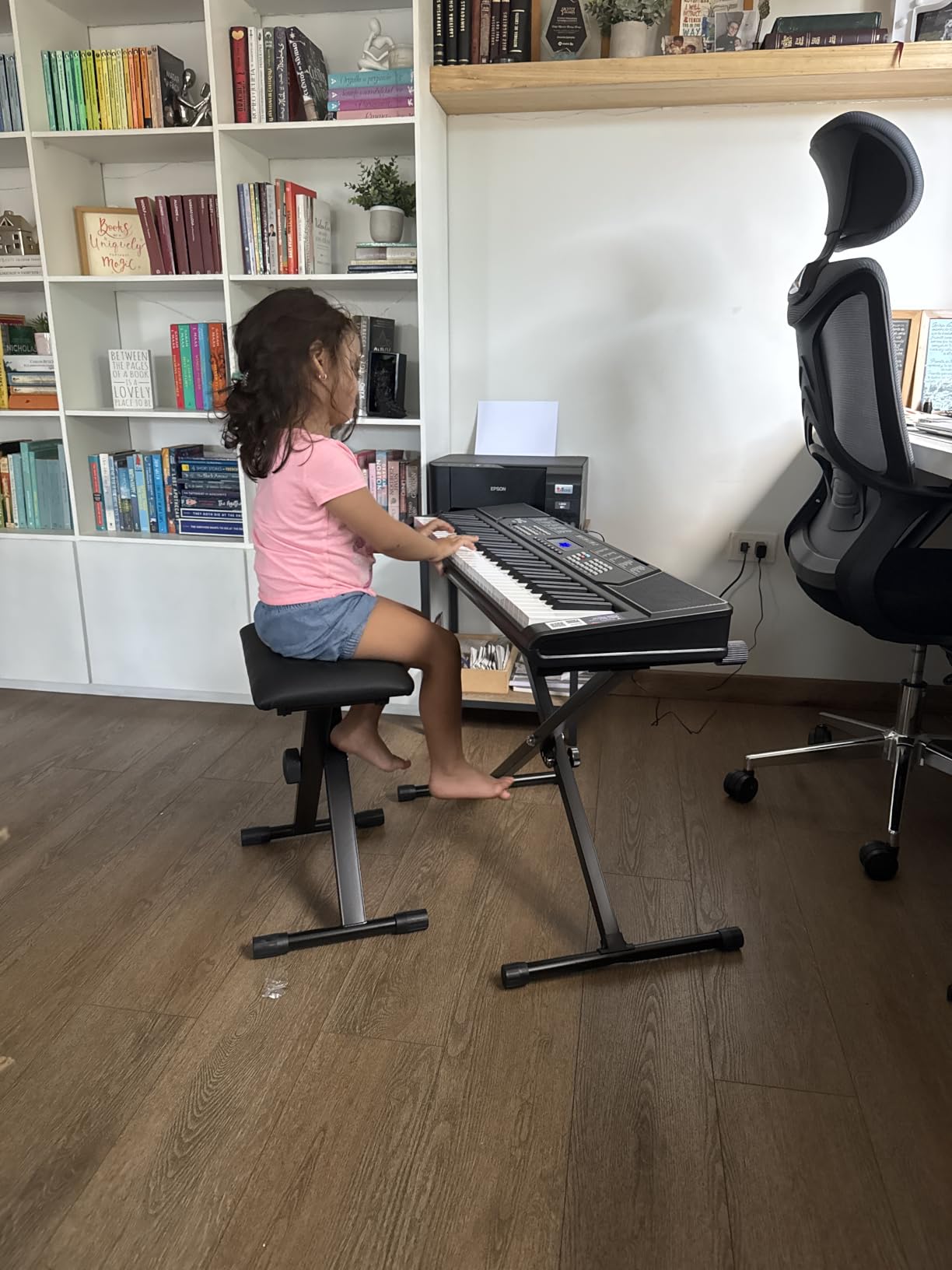
The RJ5061 solves the problem that trips up almost every other first keyboard: the missing accessories. The stand, the bench, the headphones, the sheet music rest and the note stickers all come in the box, so a child can open it and be playing on day one instead of waiting for a stand to arrive separately.
At 3.3 kg it is genuinely light for a 61-key instrument. My daughter carried it from the playroom to the living room one-handed without asking, which is not something I can say for the 6.6 lb and 9.5 lb models in this list.
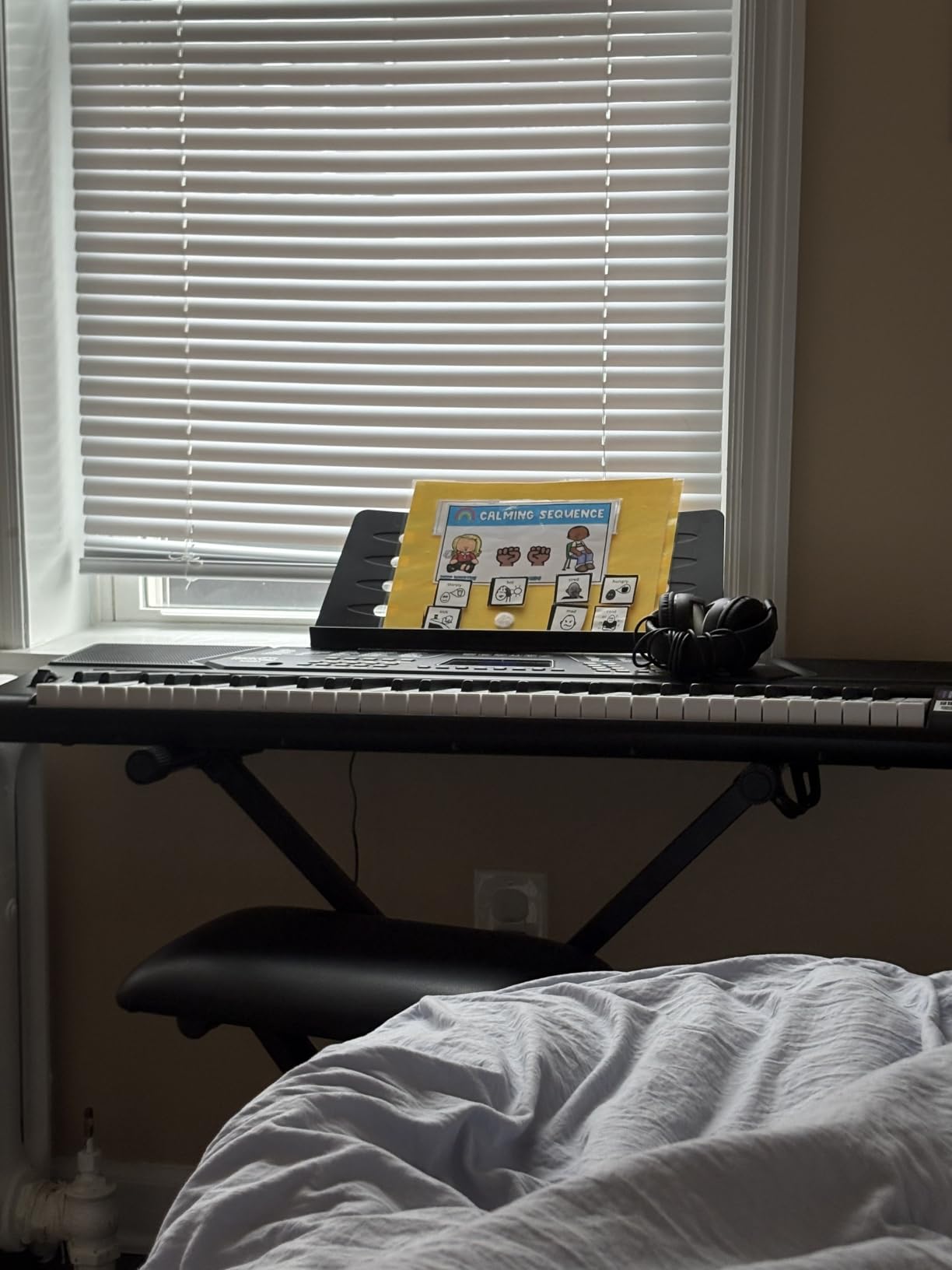
The pitch bend wheel is a nice touch that turns a beginner keyboard into something you can actually have fun on, and the LED panel gives instant visual feedback when a note lands. The 200 rhythms and 200 demo songs keep a bored seven-year-old occupied for a while, although reviewers do warn that kids tend to find the demo songs within days and use them to avoid actual practice.
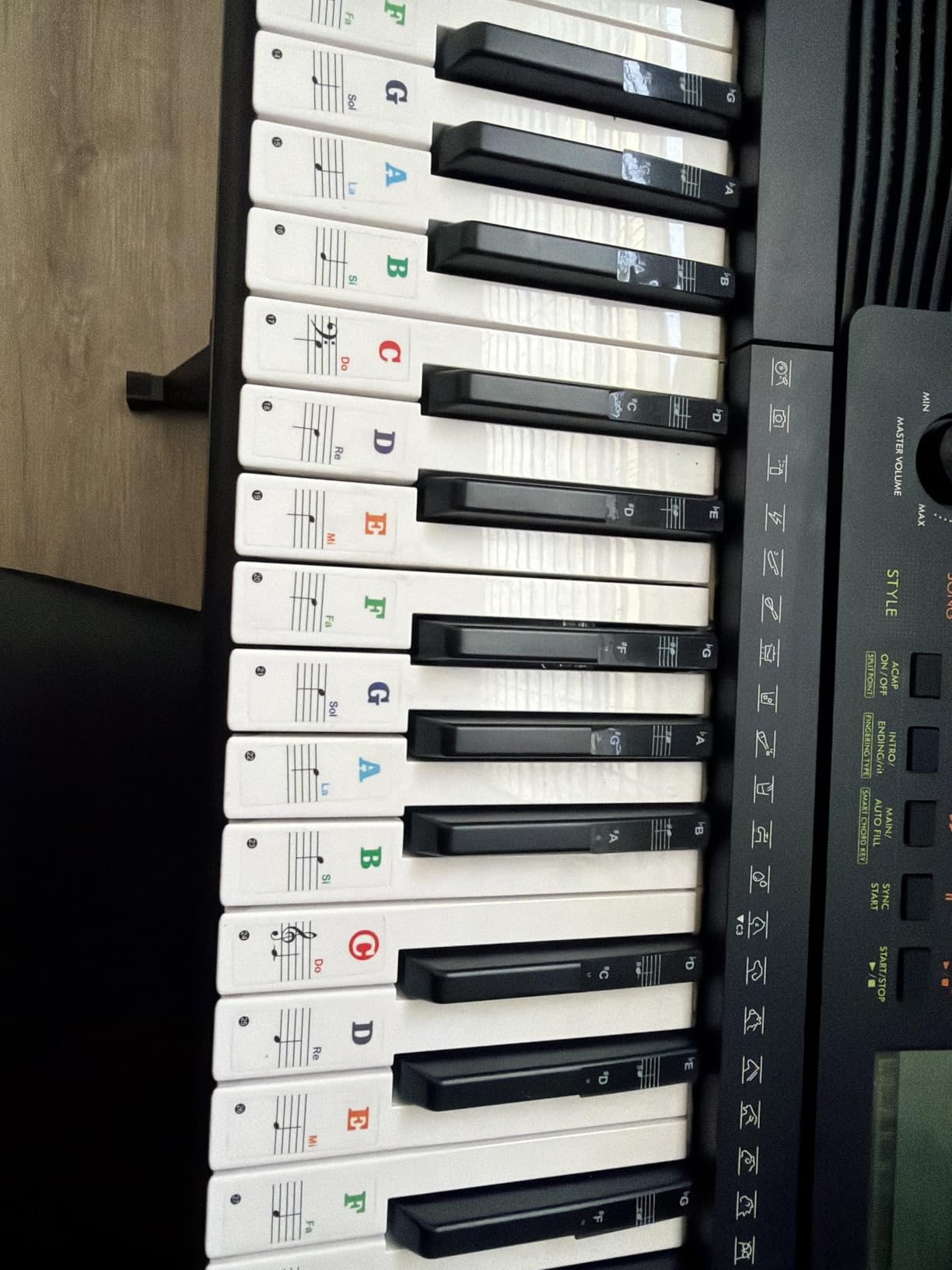
That is the honest downside of any feature-rich starter instrument, and the note stickers are the countermeasure. They give a beginner something concrete to read on the keybed while the rest of the panel is decoration.
Reviewers also point out that the headphones in the kit solve the small-apartment problem immediately, and that the assembly of the stand is simple enough for an adult to do once while the child watches.
When to choose the RJ5061
Choose it when your child is between about six and ten, has no piano in the home, and your family hates buying accessories in stages. It covers a 61-note range, which is enough for most early repertoire and all the standard method books for the first two years.
It is also the safer pick for a boisterous child because there is no separate stand to lose and no pedal to tread on repeatedly.
When to skip the RJ5061
Skip it if your child is heading toward graded exams. These are unweighted, non-touch-sensitive keys, which means louder always equals the same volume. Adults on piano forums make this point repeatedly: the jump from this to an 88-key weighted digital piano is a real adjustment of technique, not just a bigger object.
Also skip it if you want a proper instrument in a shared home. The bundled headphones cover it, but the built-in speakers are entry-level and rattle when pushed.
2. Casio CT-X700 – Best Sound Engine in the Group
Casio CT-X700 61-Key Portable Keyboard | 600 Tones | AiX Sound Engine
61 full-size keys
600 tones, 195 rhythms
9.5 lb
Touch-sensitive, USB-MIDI
Pros
- AiX sound engine sounds genuinely realistic
- 600 tones and 195 rhythms
- Class-compliant USB-MIDI with no drivers
- Integrated lesson system with 100 songs
- Moulded case survives a busy bedroom
Cons
- Menu depth is deep for the arpeggiator
- No Bluetooth
- Some buyers report a missing AC adapter
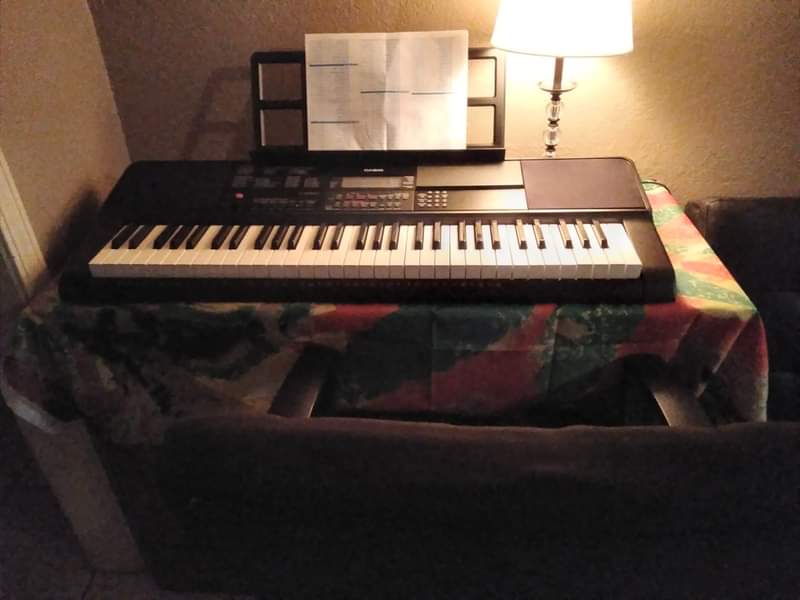
The CT-X700 is the only keyboard here where the sound engine is genuinely the headline. Casio’s AiX system carries the breath, vibrato and instrument gestures that make a plucked string sound like a plucked string, and at 600 tones you can move between a grand piano, a nylon guitar and a rock organ without hunting.
It is also touch-sensitive, which puts it ahead of the CT-S200 and the Alesis Melody 61 in the expressiveness department. A child who learns dynamics on this keyboard carries that understanding to a weighted piano later.
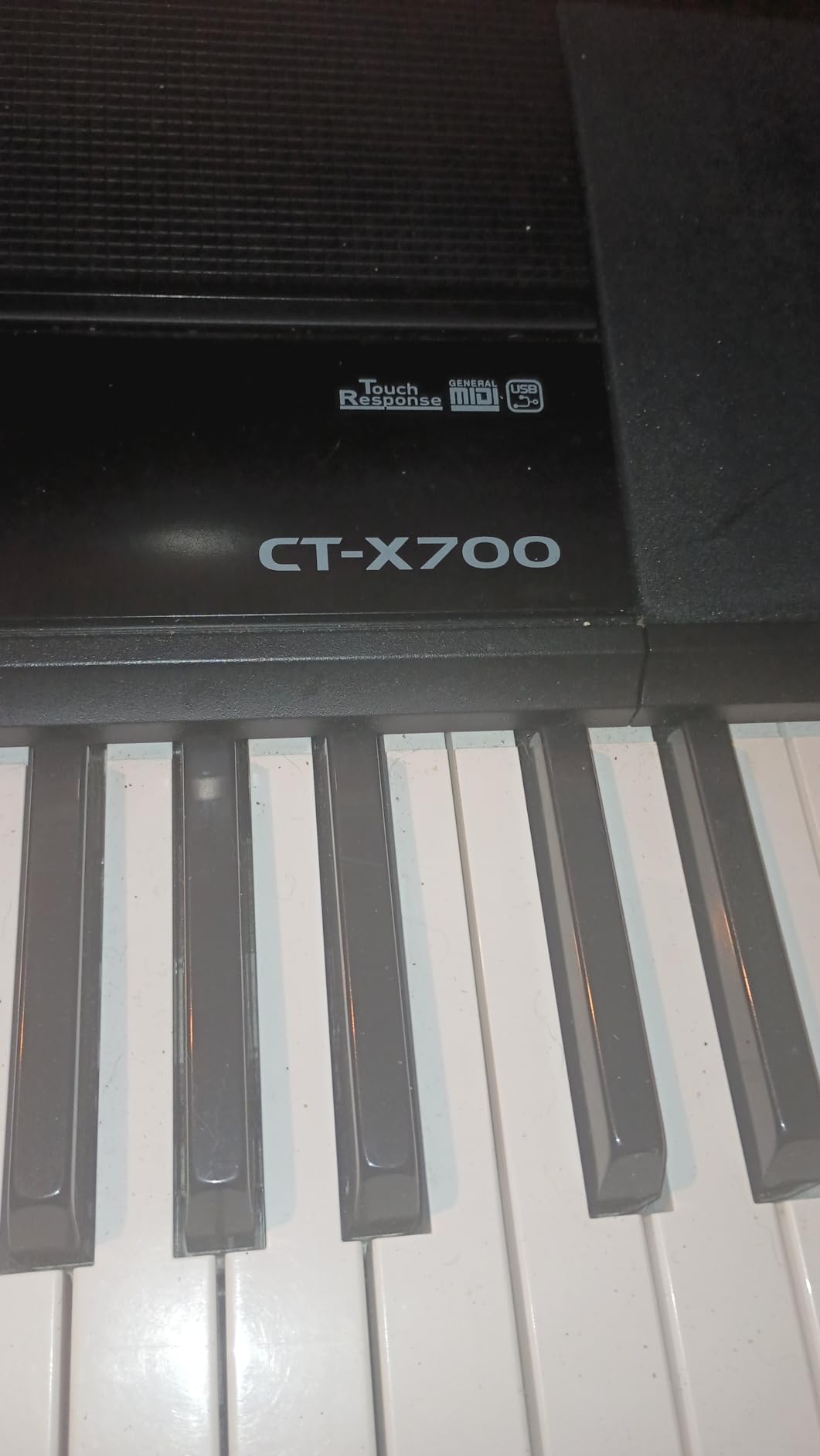
The lesson system with 100 built-in songs and Step-Up lessons is the quiet strength. It is not a gimmick that lights keys up; it walks through material in order, and the 6-track MIDI recorder lets a child record a first attempt and immediately hear how it differs from the second.
USB-MIDI is class-compliant, so it connects to a Mac, PC, tablet or phone without hunting for drivers. For a child on a music-learning app, that removes a genuine setup barrier.
The tradeoff is weight at 9.5 lb and a menu that takes practice. Reviewers commonly describe the arpeggiator as buried several levels deep, and a seven-year-old will need help finding it for the first few weeks.
When to choose the CT-X700
Choose it for a child who is already taking lessons, aged about eight and up, and already frustrated that every keyboard sounds the same. Sound variety is what keeps that child coming back.
It also suits a family that wants to record. The 6-track recorder is a real multi-track device, not a novelty.
When to skip the CT-X700
Skip it for a young child who will not read the display well and does not need 600 tones. A nine-year-old can operate the menu; a five-year-old cannot, and a simpler panel keeps practice going.
There is no Bluetooth audio or Bluetooth MIDI here, so connecting to a phone means a cable. Some buyers also report the power adapter missing from the box, so check the contents the moment it arrives.
3. RockJam RJ549 – Best Value 49-Key Start
RockJam RJ549 49 Key Keyboard Piano for Beginners with Note Stickers
49 keys
200 tones and rhythms
1.66 kg
Battery powered, note stickers
Pros
- Genuinely low entry cost
- 1.66 kg is easy for a child to carry
- Survives drops according to reviewers
- Note stickers and Simply Piano lessons
- Multiple colour options
Cons
- Keys are smaller than full-size piano keys
- Battery compartment can sit awkwardly
- Some reports of speakers failing over time
The RJ549 is the pick for a five-year-old with small hands and a short attention span. Forty-nine keys covers just over three octaves, which is the range a first method book actually uses, and at 1.66 kg it is the lightest full-featured keyboard in the roundup after the roll-up pads.
Reviewers describe it as the one that gets dropped and keeps working, which matters more than it sounds. First instruments live on floors, and a case that survives being stood on is worth real money over a five-year span.
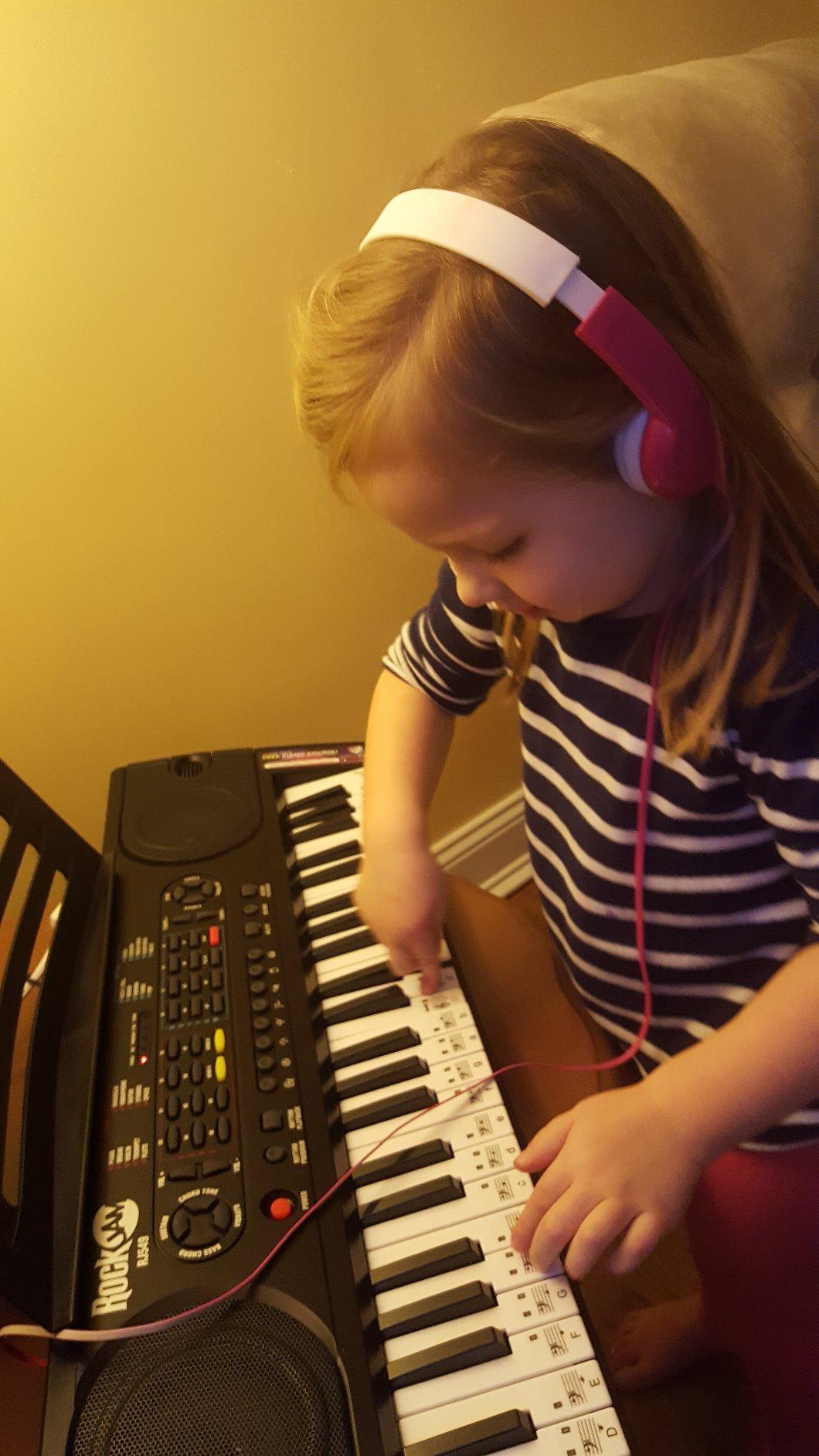
The note stickers and the Simply Piano lessons give a starting point that does not require an adult to sit and explain note names. Battery power means it can move to a different room without a cable, and the headphone jack means that room can be a bedroom after bedtime.
Colour options are a genuine factor at this age, and having a choice between finishes has an outsized effect on whether a child claims the instrument as theirs.
The honest problem is the transition. Those keys are smaller than full-size piano keys, and the jump to a 61-key or an 88-key board later is exactly the re-teaching moment parents on piano forums complain about most.
When to choose the RJ549
Choose it for a four-to-seven-year-old, especially a child who is not yet reading sheet music comfortably. The small keys and the sticker system remove two common sources of frustration in a first month of lessons.
It is also the right pick for a second child in the house who shares a room with a sibling already on lessons.
When to skip the RJ549
Skip it if you already know your child will be taking graded exams. Mini key sizing is the single thing teachers complain about most when a student transfers, and you avoid the whole problem by starting at full size.
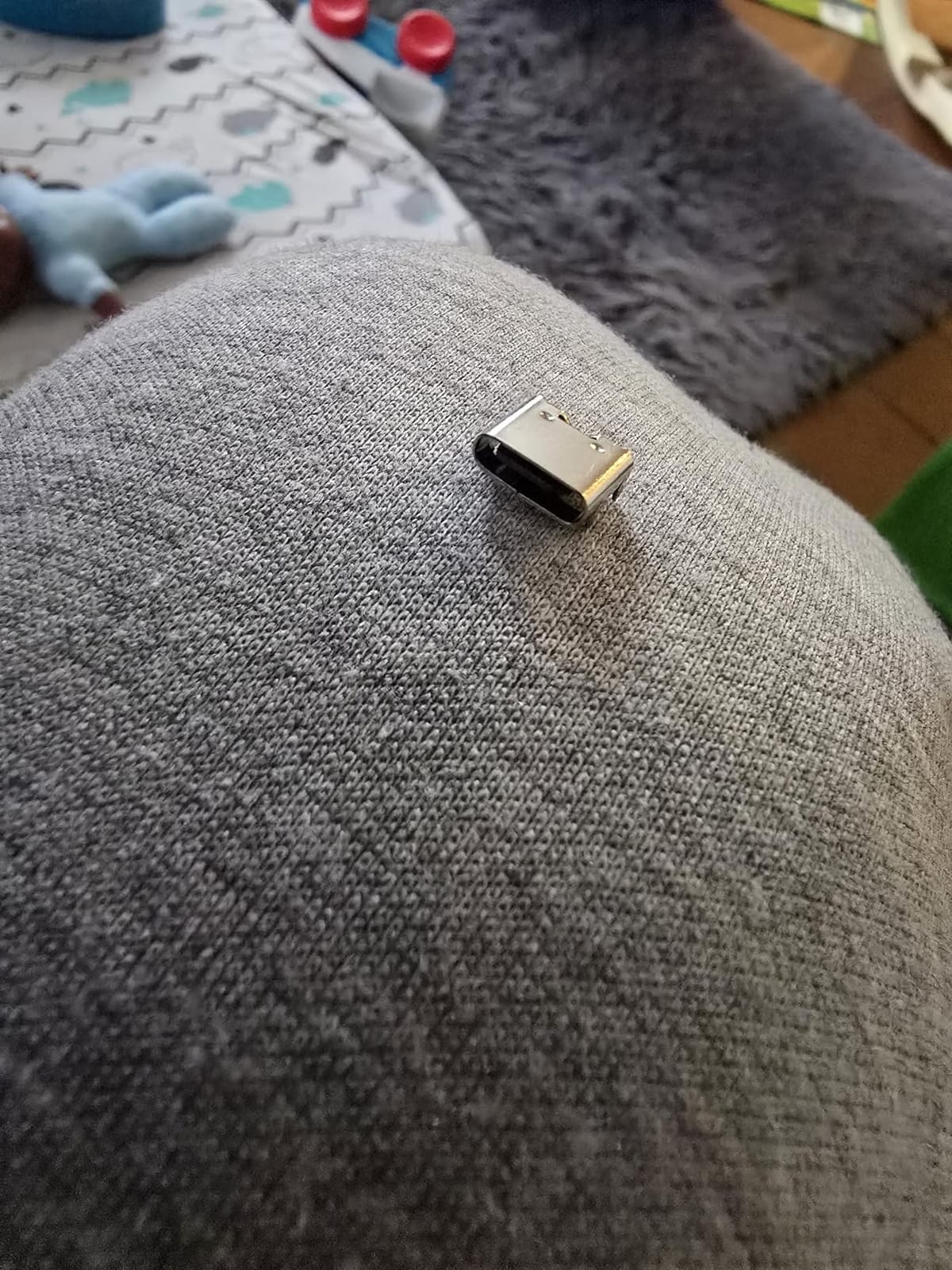
Reviewers also report the battery compartment not seating properly with cells inserted, and some reports of speaker failure after extended use. Both are worth checking within the return window.
4. PicassoTiles PT49 Roll-Up – Best for Toddlers and Travel
PicassoTiles Electronic Piano 49Key Flexible Roll-Up Keyboard with Recording Feature 8 Tones 6 Demo Songs Built-in Speaker Educational Music Toy for Kids Toddlers Boys Girls Rainbow Color Design PT49
49 flexible silicone keys
8 tones, 6 demo songs
0.74 kg
Rolls into a small box
Pros
- Rolls up to the size of a book
- Lightest option here at 0.74 kg
- Non-toxic silicone for young children
- Recording and playback feature
- Battery or USB power
Cons
- Sound is toy-like rather than realistic
- Keys are not touch-sensitive
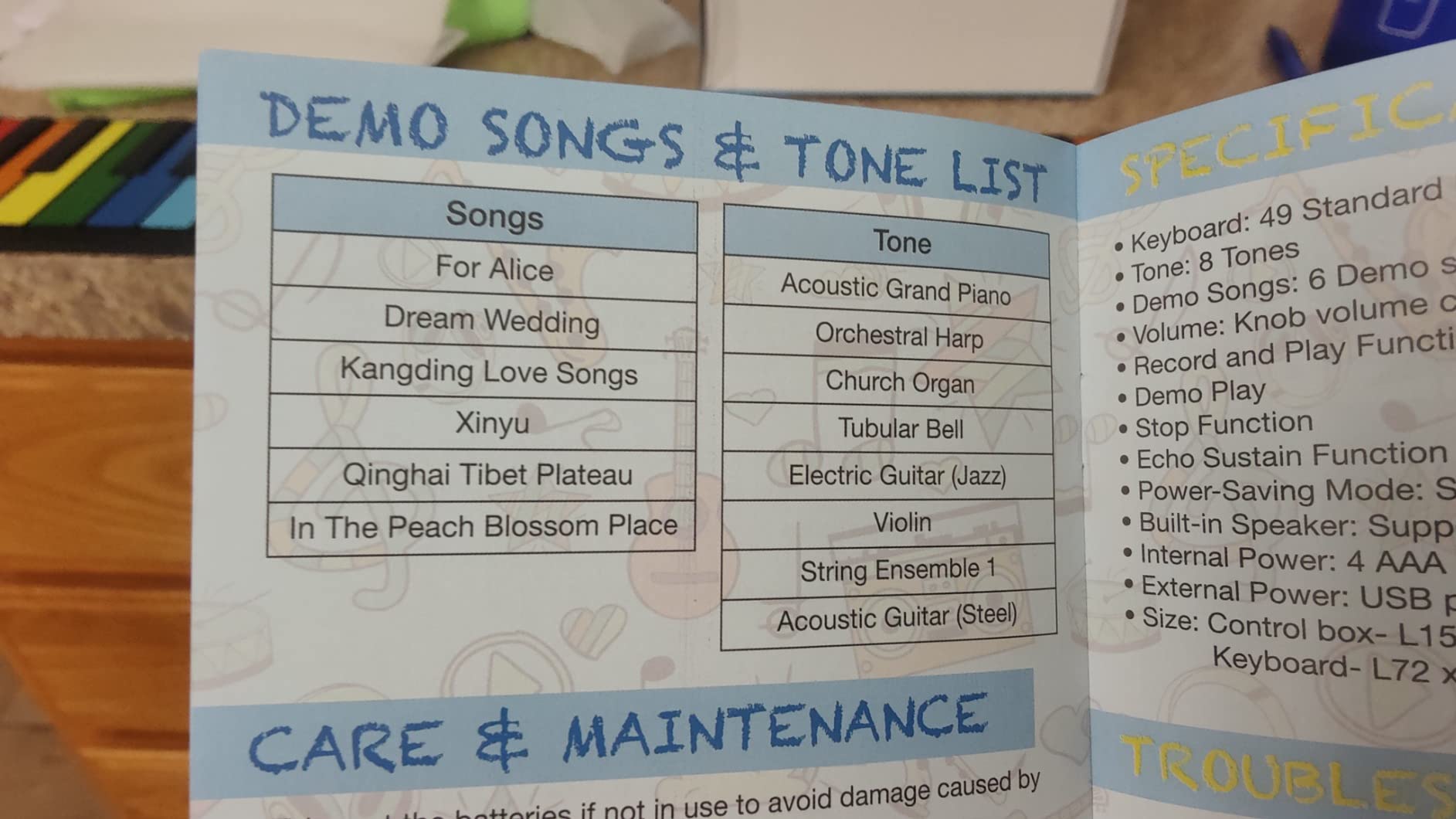
- Only 8 tones and 6 demo songs
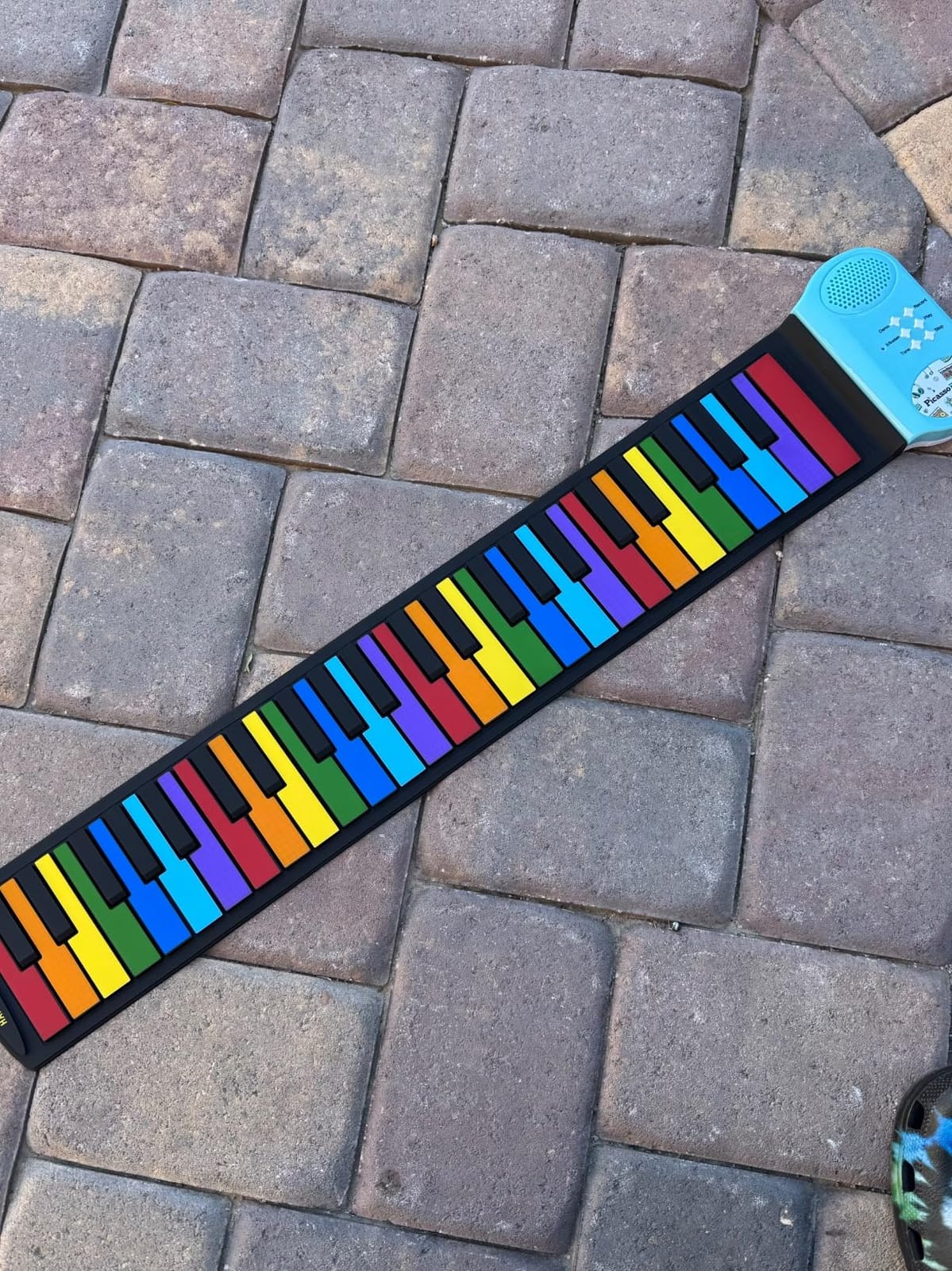
This is not a practice instrument, and treating it as one is the most common mistake with roll-up keyboards. It is a first musical experience for a three- or four-year-old, a toy that happens to have 49 keys and a rainbow colourway, and at 0.74 kg it is the one instrument in this list a four-year-old can pick up unassisted.
The roll-up design is genuinely useful in a small home. It stores behind a sofa instead of taking up a metre of wall, and it goes in a rucksack for holidays, which no rigid keyboard can do.
The recording feature is the sleeper. A child who records their own playing and then plays it back has learned cause and effect, which is a real musical concept that a passive toy cannot teach.
Visual key cues and colour-coded silicone give an adult something to point at while naming a note, and the non-toxic material specification is the detail that matters most for a child who chews on things.
Seven demo songs and eight tones is genuinely all it offers. That limit is the point: fewer options means fewer buttons to press, which is what a three-year-old needs.
When to choose the PT49
Choose it for a child aged three to five who is not yet having formal lessons. It is also the only keyboard here that fits in a travel bag, so it works for holidays, waiting rooms and grandparents houses.
For a child with limited hand strength or attention, the thin flexible bed is easier to reach across than a rigid keybed.
When to skip the PT49
Skip it the moment your child asks to learn real songs, which usually happens around the age of six. The sound is toy-like, there is no touch sensitivity, and reviewers consistently note that trills and fast passages do not register cleanly on silicone keys.
Treat it as a stepping stone with an end date, not as a place to practise.
5. Casio CT-S200 – Best for Carrying to Music Lessons
Casio Casiotone CT-S200 – 61-Key Portable Keyboard for Beginners | 400 Tones, 77 Rhythms, LCD Display, Dance Music Mode, USB-MIDI, Stereo Speakers | Includes Power Supply & Music Rest | Black
61 full-size keys
400 tones, 77 rhythms
7.3 lb
Built-in carry handle, battery power
Pros
- Built-in carry handle makes it genuinely portable
- 7.3 lb suits an adult or older child
- 400 tones and 77 rhythms with Dance Music Mode
- Casio Music Space app over USB
- 60 songs with right-hand lesson support
Cons
- Keys are not touch-sensitive
- No weighted action
- Micro USB-B cable not included
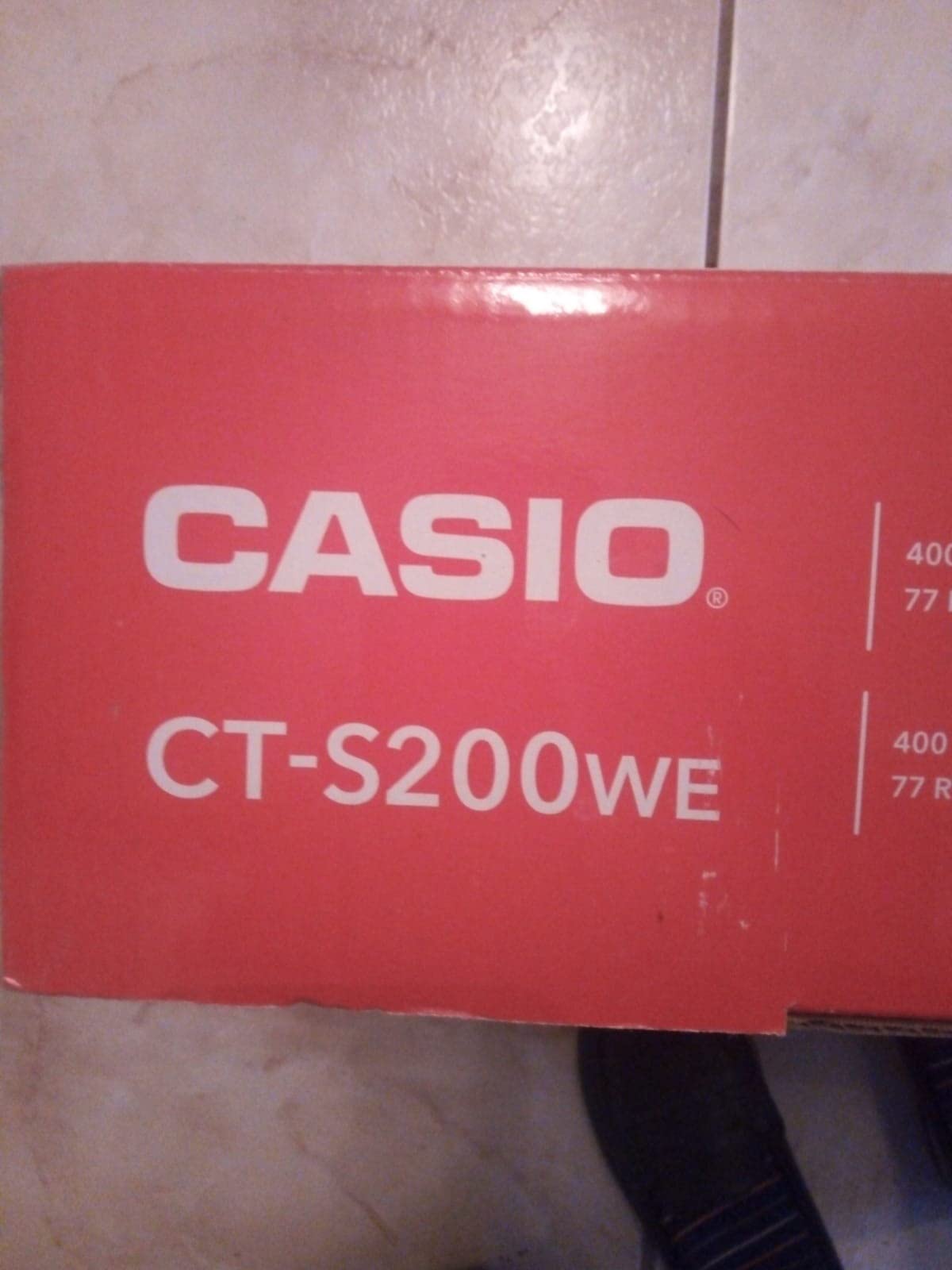
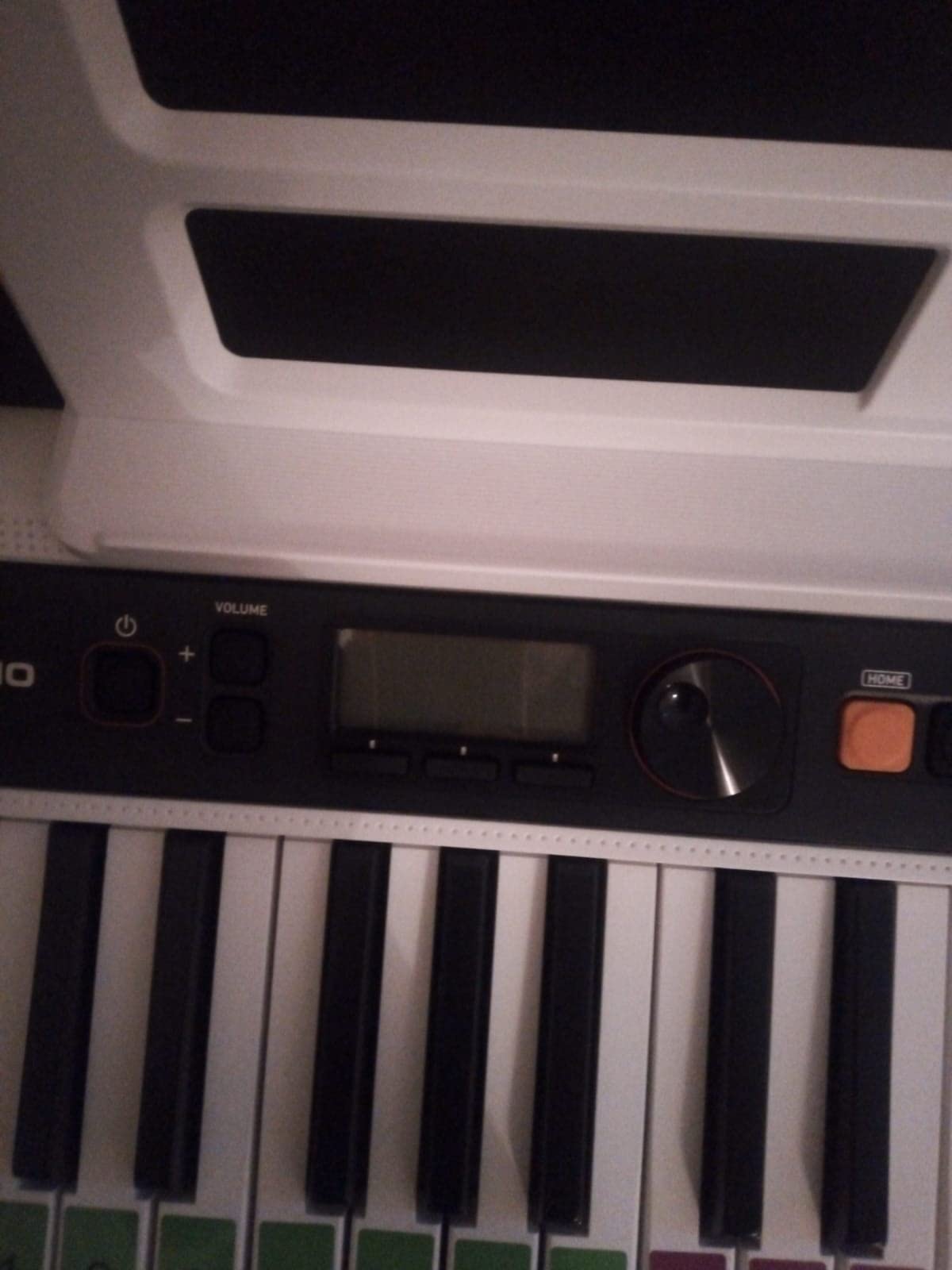
The CT-S200 is the keyboard most often recommended on piano forums as a first serious step, and the reason is simple: it is built like an instrument rather than a toy. The moulded case, the 61 full-size keys and the 7.3 lb weight sit right at the edge of what a child can carry with the built-in handle.
Unlike most of its competition it runs on batteries as well as the supplied AC adapter, so it works in a practice room that has no socket within reach.
Four hundred tones and 77 rhythms with 10 reverb types cover an enormous amount of ground, and Dance Music Mode is the feature that converts a nine-year-old who has decided music is boring. It layers and remixes electronic tracks live over the key press.
Sixty built-in songs with right-hand lesson support give a beginner structured material, and USB-MIDI works without drivers for tablet-based apps.
One important note for parents: the keys here are not touch-sensitive, which reviewers raise more than any other con. A hard press and a soft press give the same volume.
When to choose the CT-S200
Choose it for a child taking weekly lessons who has to travel with the instrument, or for a family that wants a keyboard that can move to a different room each practice session. The handle and the battery option are the whole argument.
It is also a strong first keyboard for a child with a teacher rather than an app, because the lesson songs give a teacher something to assign.
When to skip the CT-S200
Skip it for a child who is ready to develop dynamic control, because there is none. If a teacher has already mentioned expression or dynamics, move up a tier rather than buying this and disappointing both of you.
The music rest is reported as somewhat unstable, and the MIDI cable is not included, so budget a few cents for a Micro USB-B cable if you plan to use the app.
6. Hricane HEP-669S – Best for Light-Up Teaching Keys
Hricane Keyboard Piano Lighted Keys for Beginner Adults Teens Kids, 61 Key Electronic Music Keyboard with Teaching Modes Powered by USB or Battery with LCD Display Microphone Headphone Jack
61 lighted keys
200 tones, 200 rhythms
2.5 kg
4 AA batteries or USB
Pros
- Lighted keys with three teaching modes guide a total beginner
- Microphone and key stickers included
- Dual keyboard mode supports parent and child together
- 2.5 kg is easy to move
- Works on four AA batteries or USB
Cons
- Sound is described as toy-like by some reviewers
- Some reports of keys breaking
- Build quality feels cheap
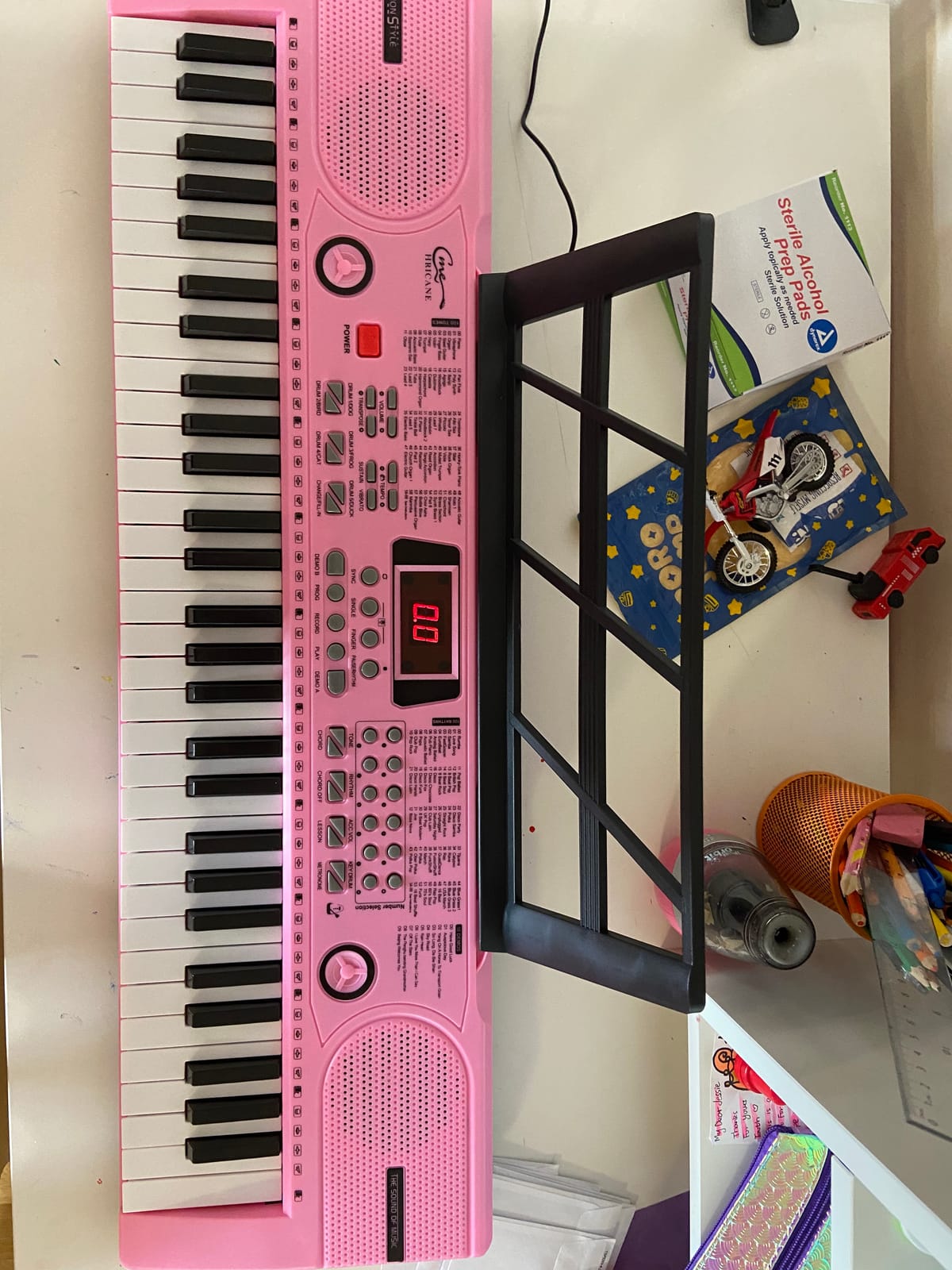
Light-up keys get dismissed in some circles as a gimmick, and on a weighted piano they would be. For a six-year-old who cannot yet read a note, though, a key that lights up is the difference between guessing and knowing, and this is the best implementation of that idea in the roundup.
Three teaching modes plus smart chords in single-finger and multi-finger versions means a child can play a full chord with one finger before they have the span for five. That head start matters more than it sounds.
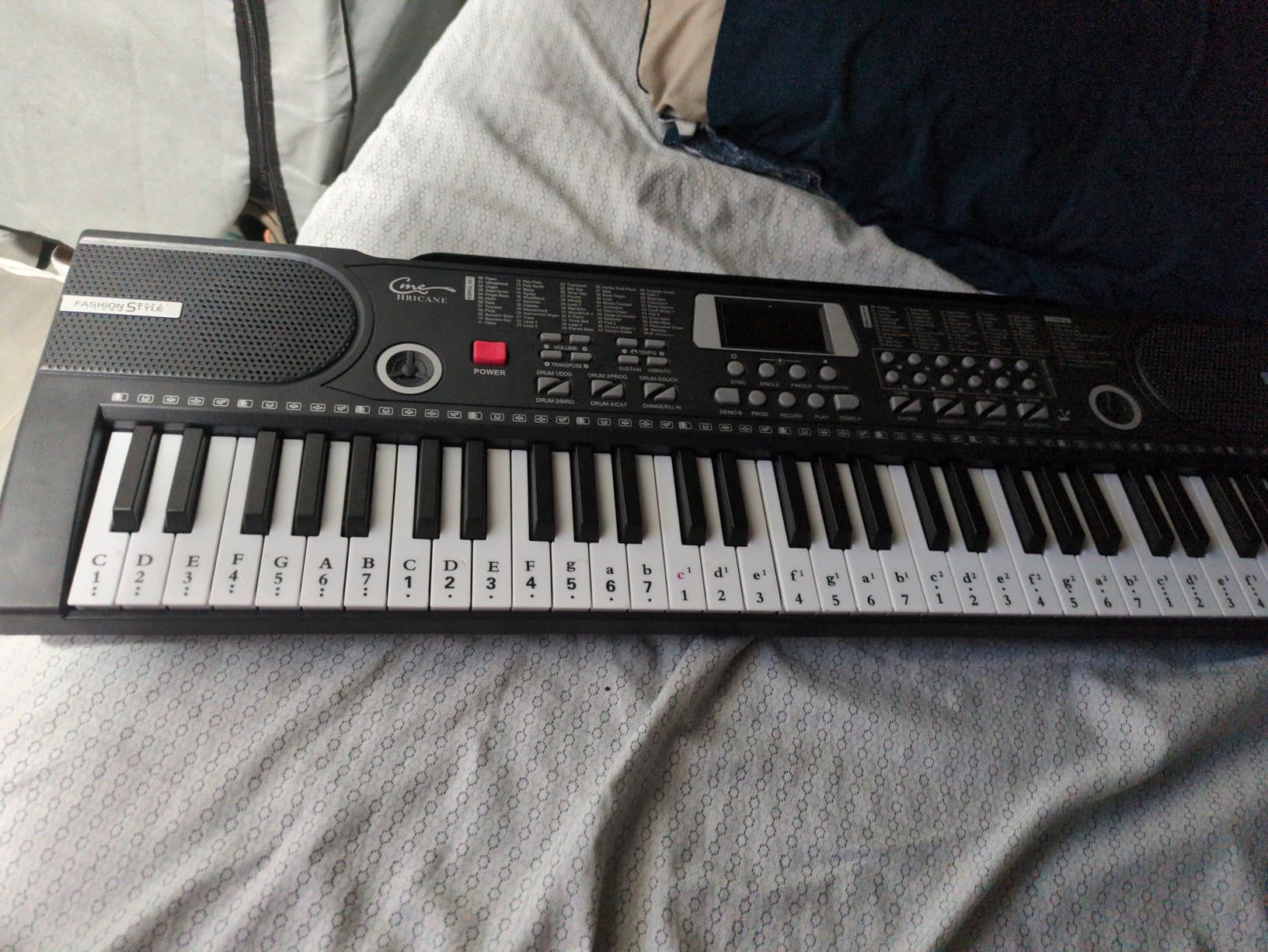
Dual keyboard mode splits the keys so a parent or sibling can play alongside, which turns practice from a solo chore into a shared activity. Recording and playback let a child hear their own attempt immediately.
At 2.5 kg and 30 inches long it is one of the easiest 61-key models for a child to handle physically, and it runs on four AA batteries as well as USB.
Durability is the weak point. Reviewers report keys that break, lights that malfunction and a build that feels cheap, so this is a pick for careful use rather than rough use.
When to choose the HEP-669S
Choose it for a child aged five to eight who cannot yet read music and loses interest within a few minutes of a lesson. The lighting gives immediate, visible success on the first day.
It is also a good pick for a sibling pair sharing one instrument, thanks to the dual keyboard mode.
When to skip the HEP-669S
Skip it for a child who is physically rough with equipment. The reports of broken keys are repeated enough that we would not recommend it for a boisterous seven-year-old who treats instruments as toys.
It is also the wrong choice for sound quality. Reviewers describe the audio as toy-like, and the included microphone is universally criticised.
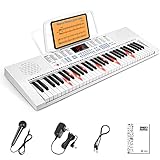
7. Vangoa VGK611 – Best Mini Keys With a Note Screen
Vangoa VGK611 Electric Keyboard for Beginner, 61 Keys Portable Music Keyboard With Mini Lighted Keys, Electronic Piano for Kids, Boy, Girl, White
61 mini keys
350 timbres, 30 demo songs
2.7 kg
6 AA batteries or cable
Pros
- Mini keys correctly sized for children's hands
- Large LED screen displays notes so stickers are unnecessary
- Three teaching modes
- Two-year warranty
- 6 AA battery or cable power
Cons
- Touch sensitivity is overly responsive
- USB and MIDI ports present but not functional
- Included microphone is poor quality
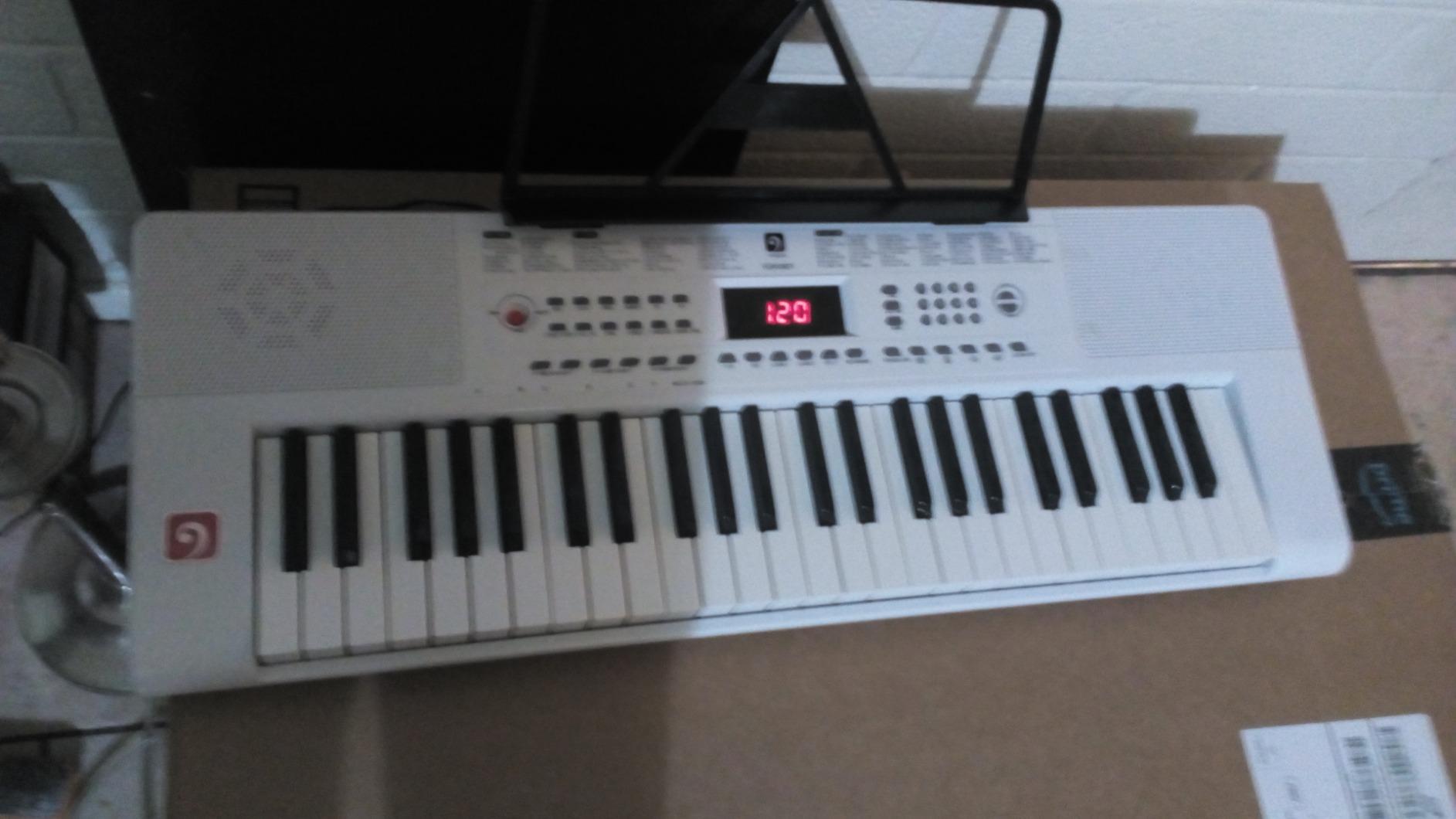
The VGK611 takes the mini-key idea further than most. Instead of stickers or lighting on the keys, it puts a large LED screen above the keybed that displays the note being played, which means a child can read the note name while their hand is still in position.
That screen is the single best teaching feature in this roundup for a four-to-seven-year-old, and reviewers consistently single it out as the reason the lighting is not just decoration.
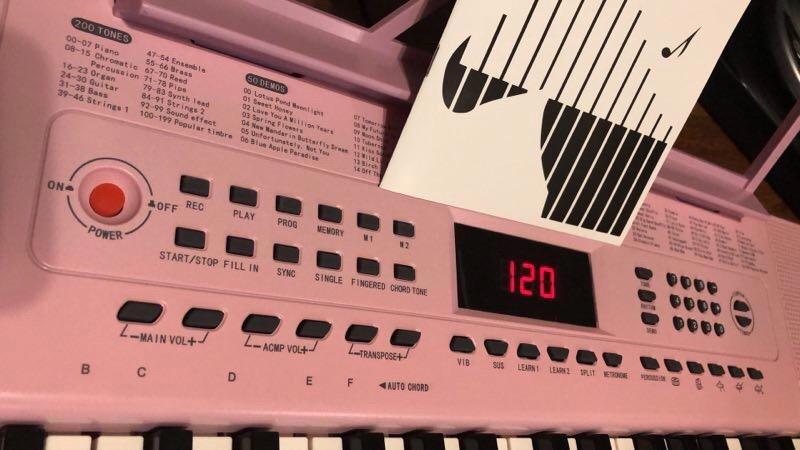
Sixty-one mini keys with 350 timbres and rhythms, 30 demo songs and 8 percussion types is a lot of content for a 2.7 kg body. Sustain, vibrato, dual keyboard, chord, recording and playback functions are all present.
It runs on six AA batteries or a charging cable, so it can move between rooms. The default volume is moderated, which is a sensible detail when a child shares a wall with a sleeping sibling.
It carries a two-year warranty and lifetime after-sales service, which on a less-known brand is worth more than it sounds, because service access is the main risk with any brand you have not heard of.
When to choose the VGK611
Choose it for a four-to-seven-year-old whose fingers still struggle to reach across standard-size keys. A large LED note display removes the most common early frustration of not knowing what to press next.
It is also a reasonable choice for a child moving up from a roll-up pad who needs more range without a full-size hand span.
When to skip the VGK611
Skip it if you are near a full-size transition anyway, because the mini key sizing is the thing you eventually move away from. Reviewers also find the touch sensitivity overly responsive, which frustrates children trying to play softly.
Check the ports before you commit. Reviewers report USB and MIDI connections that are physically present but not functional, which is a disappointment if you bought it for a tablet app.
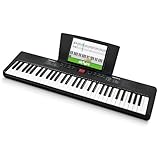
8. Alesis Melody 61 MK4 – Best for Included Online Lessons
Alesis Melody 61 MK4 61-Key Piano Keyboard
61 full-size keys
300 sounds, 300 rhythms
6.6 lb
Skoove and Melodics access
Pros
- Three months of Skoove and Melodics lessons included
- 300 sounds with layer and split
- Metronome and record mode built in
- Sustain pedal input and aux input
- 6.6 lb is portable without a handle
Cons
- Keys are not touch-sensitive
- Some reports of the power adapter failing
- Stand and bench not included
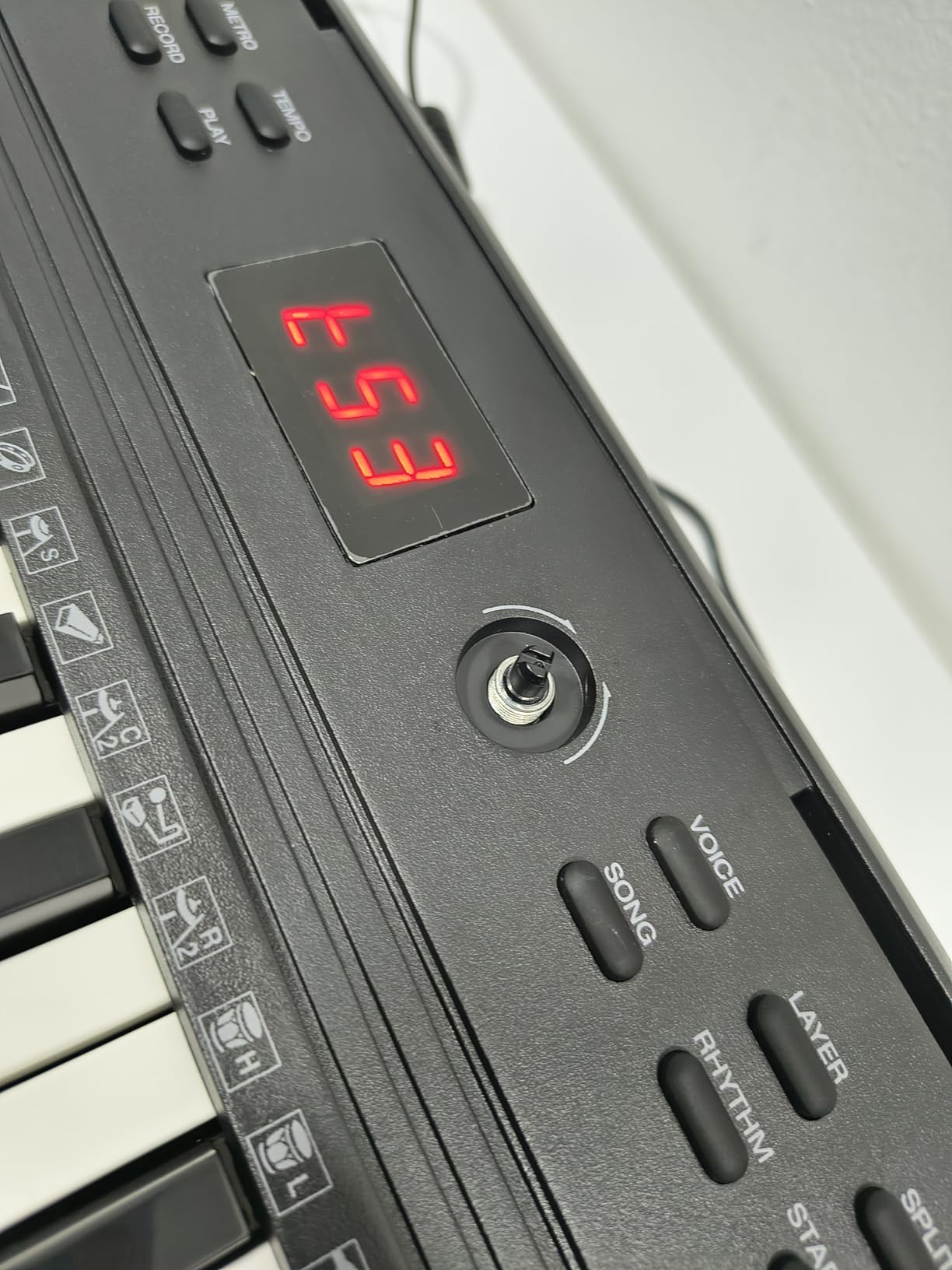
The Melody 61 MK4 makes its case with content rather than hardware. Three months of Skoove and Melodics lessons arrive with it, which is a structured curriculum a parent does not have to source, and the metronome and record mode let a beginner practise against a pulse and review the result.
Three hundred sounds with layer and split modes, plus 300 accompaniment rhythms with auto-chord, is more variety than most children will consciously notice but more than enough to keep them returning.
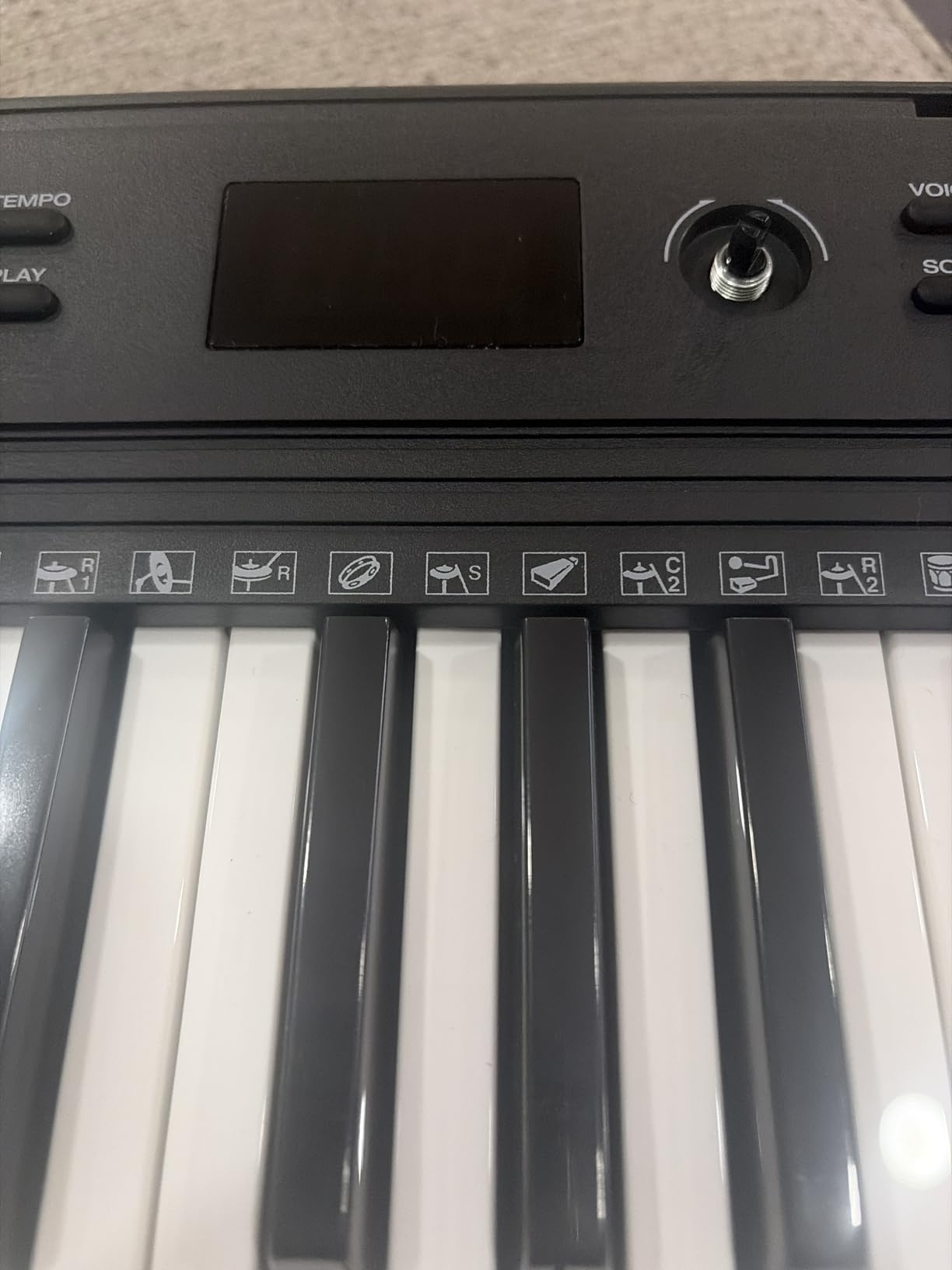
At 6.6 lb it sits in the middle of the weight range here. Light enough for a 37-inch keyboard to cross a room, heavy enough that it stays put on a table when a child plays enthusiastically.
The connections are properly thought out: USB-MIDI for recording software, a quarter-inch sustain pedal input so a damper pedal works from day one, an aux input and a headphone output.
It runs on six AA batteries if you buy them separately, which removes the socket problem in a practice room. The piano tone itself is on the synthetic side, which is the fair criticism of the basic sound.
When to choose the Melody 61 MK4
Choose it for a child aged seven to eleven who will practise alone for twenty minutes most days. Having lessons already loaded removes the daily negotiation over what to play.
It is a good fit if you want a damper pedal input and a metronome without going near a digital piano budget.
When to skip the Melody 61 MK4
Skip it if the included lesson subscription matters less than key feel. The keys are not touch-sensitive, so volume control is absent, and reviewers describe the build as somewhat fragile.
There are also reports of the power adapter failing after a couple of months, so keep the receipt and test it early rather than assuming it works.
9. Yamaha PSR-E283 – Best for Ear Training
Yamaha 61-Key Portable Keyboard for Beginners with Learning Tools, Music Rest and Power Adapter PSRE283
61 full-size keys
Hundreds of built-in songs
8.8 lb
Battery or AC, Flowkey compatible
Pros
- Quiz Mode turns ear training into a game
- Portable Grand Piano button gives an instant good piano sound
- Smart Chord plays full chords with one finger
- Full-size keys from the start
- Yamaha build and tuning
Cons
- Highest cost in this roundup
- Smaller review base as a newer model
- Stand and bench not included
The PSR-E283 is the pick for a child with a teacher who talks about listening. Quiz Mode runs two ear-training games that ask a child to identify notes and rhythms by ear, which is the single most transferable musical skill on this list and the one most beginner keyboards never touch.
The Portable Grand Piano button is the other reason to like it. One press sets a rich piano sound, which means a beginner experimenting with the panel cannot accidentally end up on a harsh organ patch and conclude that music is unpleasant.
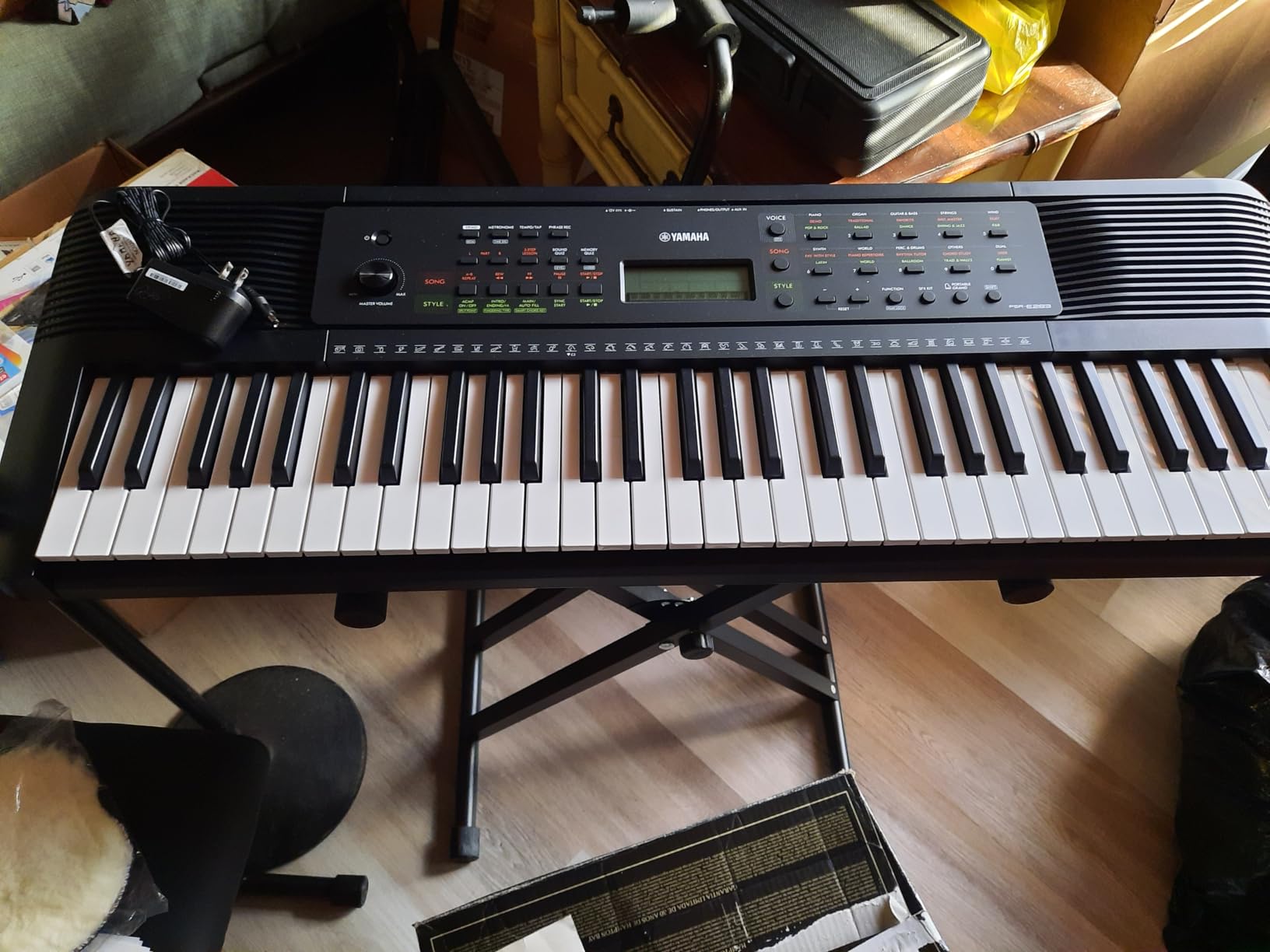
Smart Chord does the same job for harmony: one finger produces a full chord, so a six-year-old can accompany a melody on their first lesson instead of waiting until their hand span catches up.
It runs on batteries or the included AC adapter, works with the Flowkey app over USB, and ships with a music rest. Hundreds of built-in songs cover children’s repertoire alongside pop and classics.
It is the heaviest of the 61-key models here at 8.8 lb and the most expensive, and its review base is smaller because it is a newer model.
When to choose the PSR-E283
Choose it for a child aged seven to eleven who takes formal lessons, where aural skills are assessed and rewarded. Quiz Mode supports exactly that.
It also suits a family that plans to keep this keyboard for several years and would rather not move up to a weighted instrument as soon as lessons start.
When to skip the PSR-E283
Skip it on budget. It costs more than every other 61-key model in this roundup, and if the money is tight the difference is better spent on a stand, a bench and a pair of headphones.
It is also not touch-sensitive according to the specification sheet, so if dynamics matter to your teacher this is not the model.
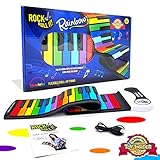
10. MUKIKIM Rainbow Roll-Up – Best for Colour Learning and Storage
MUKIKIM Rock and Roll It – The Original Rainbow Piano. Roll Up Flexible Piano Keyboard for Kids / Beginners. Portable 49 Keys Silicone Pad. Play-by-Color Songbook Included!
49 silicone keys
Play-by-Color songbook
1.4 lb
MIDI over USB, record and playback
Pros
- Play-by-Color songbook uses industry-standard colour coding
- 1.4 lb and rolls up for storage
- Colour-coded keys match early music education methods
- MIDI over USB for computer use
- Spill-resistant silicone
Cons
- Key action is inconsistent
- Speaker crackles at high volume
- No velocity sensitivity
The MUKIKIM is the most considered of the roll-up options, and the reason is the Play-by-Color songbook. The colours on the keys follow the coding used in early music education, so a child can read a colour-coded songbook directly off the instrument without an adult translating anything.
That makes it the best roll-up choice for a four-to-six-year-old who can already recognise colours but cannot yet read music, which is a surprisingly large group.
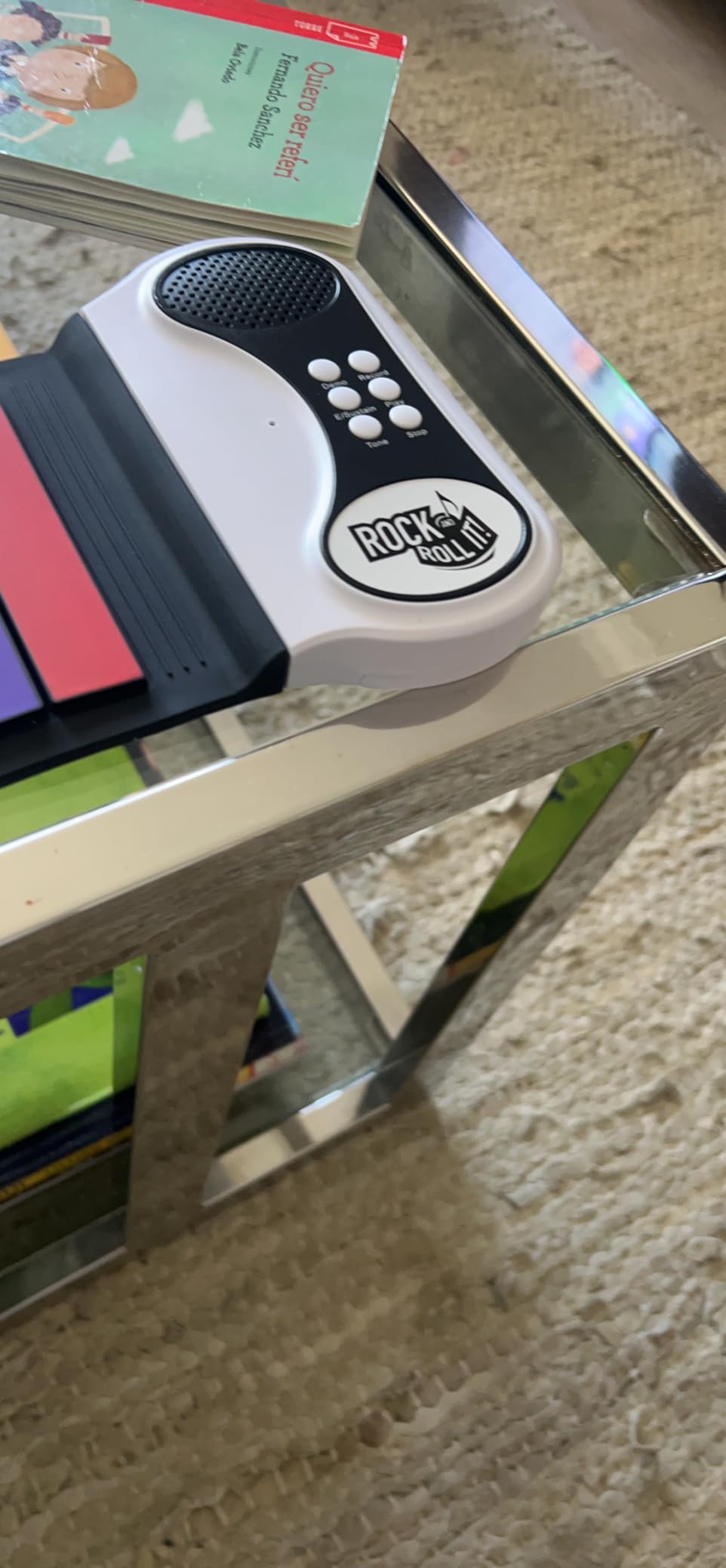
It weighs 1.4 lb, runs on batteries or the included USB cable, and rolls up to 31 by 6 inches for storage. Reviewers also point out it works on a wheelchair tray, which is one of the few reasons to choose a roll-up over a rigid board on accessibility grounds.
Record, playback, echo and sustain functions are there, and MIDI over USB means it can drive a computer, a small point that makes it more useful than it looks for an older child.
The weaknesses are consistent: inconsistent key action where notes fail to register, a speaker that crackles when pushed, and no velocity sensitivity at all.
When to choose the MUKIKIM
Choose it for a child aged four to seven who is drawn to colour-based learning, or for any home where a rigid keyboard simply will not fit the storage available. It is the easiest model here to move between rooms.
It is a good travelling option for holidays and for keeping practice going while staying with relatives.
When to skip the MUKIKIM
Skip it once lessons become structured. Inconsistent key action will frustrate a child who is trying to play a specific piece, and no velocity sensitivity means dynamics never arrive.
Reviewers also call out the cost relative to the build quality, and the short USB cord as an annoyance for a laptop user.
How Many Keys Does a Child Need to Start?
Start with 61 full-size keys if your child is five or older and taking lessons. That is five octaves plus a minor third, which covers standard beginner repertoire without a child ever running out of range mid-song.
Under five, or for a child who cannot comfortably span a full-size key, 44 to 49 mini keys is enough to play real music rather than only pressing buttons. Below three, a roll-up pad is the right form factor for reasons of weight and safety, not musicality.
Never go straight to 88 keys for a beginner unless the instrument is a weighted digital piano. Adults on music forums make this point repeatedly: a full 88-key board is a larger target and a longer journey, and it does not make a five-year-old better faster.
One compromise works well: a 61-key portable now as a travel instrument, with the plan to add a weighted digital piano around age nine or ten when technique is established.
Casio vs Yamaha: Which One Suits Kids Better?
Casio wins on portability and app support; Yamaha wins on teaching structure and brand service. If your child will carry the instrument to lessons, the Casio CT-S200 is the more practical choice at 7.3 lb with a built-in handle and battery power.
If your child is taking formal lessons with a teacher, the Yamaha PSR-E283 is the stronger instrument because Quiz Mode trains aural skills and Smart Chord removes early hand-span barriers. Its downside is cost and an 8.8 lb weight with no handle.
For sound quality specifically, the Casio CT-X700 leads this roundup with the AiX engine and touch-sensitive keys. Yamaha’s advantage on the PSR-E283 is the lesson layer rather than the raw tone.
Both brands have service networks and both publish parts diagrams, which matters far more than tone count when a child breaks a key at seven. Our picks for the best mechanical keyboards for writers cover the opposite end of the spectrum, for a grown-up desk.
Are Mini Key Keyboards Bad for Children?
No. Mini keys are correctly sized for a small hand, and a child who starts on 44 mini keys learns proper finger numbering and hand position rather than developing a hunched posture reaching across full-size keys.
The real cost is the transition. When a child moves up, the hand has to relearn spacing, and parents describe that as the most frustrating month of early piano. The practical fix is to buy a 61-key model with full-size keys as soon as the child can span them, usually around age seven.
Two roll-ups in this list, the PicassoTiles PT49 and the MUKIKIM, sit at the toy end of that spectrum and are only worth buying for a child under six.
One extra point from the research: a keyboard with no velocity sensitivity is a bigger developmental gap than mini keys. It removes the link between how hard a child presses and what they hear.
Keyboard or Digital Piano: What Actually Changes
A portable keyboard gives you hundreds of sounds, rhythm accompaniment and a light unweighted keybed. A digital piano gives you 88 weighted keys, a realistic acoustic action and a small number of well-made sounds.
Everything in this roundup is a keyboard. That is the right choice for a first instrument in most homes, because the portability, the volume control and the lesson features matter more in year one than weighted action does.
The switch to a digital piano usually makes sense around age nine or ten, when a child is practising daily, wants to learn classical repertoire, or starts working toward graded exams.
Adults on piano forums are firm on the distinction: a keyboard teaches you notes, a weighted keybed teaches you dynamics. Both stages have value, in that order.
The Full Setup Checklist for a Kids Keyboard
Budget for four accessories beyond the keyboard itself, because skipping them is how families end up with an instrument on a bedroom floor that nobody plays.
A stand is the first item. A keyboard played flat on a table teaches a child the wrong posture, and the wedge shape of a desk does not replicate a proper arm angle. A height-adjustable X-stand costs very little and fixes the problem entirely.
A bench matters second. Without one, a child perches, and perching leads to fatigue within ten minutes.
A damper pedal is third, and only keyboards with a pedal input can use one. The Alesis Melody 61 MK4 and the Casio CT-X700 both have a proper quarter-inch pedal jack.
Headphones are fourth, and they are not optional in a shared home. Reviewers describe late-night practice in flats as the single most common reason practice gets abandoned.
A music rest comes in the box with several models here, but if yours lacks one, buy it. Reading from a screen or a phone changes hand position.
One more item worth considering: a small bookshelf or wall mount with a two-brace stand, because the single-brace stands included with budget kits are the first thing to wobble.
What to Avoid in a First Keyboard
Avoid unbranded listings with thin review counts and ratings around two stars. The shopping results for this topic are full of them, and the pattern in those reviews is consistent: stiff keys that do not respond properly, tinny single speakers and no service network when something fails.
Avoid keyboards with no touch sensitivity if your child is six or older. It is the hardest limitation to unlearn, because a child who never hears dynamics assumes playing louder and playing better are the same thing.
Avoid feature counts above 400 sounds for a beginner. A large panel with hundreds of voices, dozens of rhythms and deep menus actively slows a first-year student down. Three hundred sounds is more than enough.
Avoid anything where the stand is a single-brace X-stand included in the box, and avoid single-brace stands in general for a child who leans on the instrument.
Avoid buying a used keyboard without testing every key. Play each one, watch for notes that do not register, and check the power supply. A dead key discovered at home means a long wait for a part.
And avoid skipping the age check. The most common wasted purchase is a full 88-key digital piano bought for a four-year-old, which is a heavier object, a longer learning distance and no more musical benefit.
Frequently Asked Questions
What is the best beginner keyboard for a child?
The best beginner keyboard for a child is one with 61 touch-sensitive full-size keys, a sustain pedal input, a headphone jack and a body light enough for the child to carry. The RockJam RJ5061 is the most complete starting point because the stand, bench and headphones are included, while the Casio CT-X700 is the strongest choice once sound quality starts to matter.
What is the best keyboard for a 7-year-old?
At seven, move to a 61-key full-size board rather than a mini-key model. The Casio CT-S200 at 7.3 lb with a carry handle and battery power suits a child who travels to lessons, and the Alesis Melody 61 MK4 suits one who practises alone thanks to its included Skoove and Melodics lessons and built-in metronome.
What are some good mini keyboards for kids?
For mini keys, the Vangoa VGK611 leads with 61 mini keys sized for children’s hands and a large LED screen that displays the note being played. The RockJam RJ549 is the simpler 49-key option with note stickers, and the MUKIKIM and PicassoTiles roll-ups are the lightest choices for a child under six.
Is Casio or Yamaha a better keyboard for kids?
Casio wins on portability and app support, with lighter bodies, carry handles and battery options. Yamaha wins on teaching structure, with Quiz Mode ear training and Smart Chord on the PSR-E283. Choose Casio for a child who carries the instrument to lessons and Yamaha for a child taking formal lessons with a teacher.
How many keys does a child need to start piano?
A child starting lessons at five or older needs 61 full-size keys, which gives five octaves and covers standard beginner repertoire. Under five, 44 to 49 mini keys is enough to play real music with correct finger position. Going straight to 88 keys is only worthwhile if the instrument is a weighted digital piano.
Do kids need weighted keys to start piano?
No. Weighted keys are not required for a first instrument, and light unweighted action is easier on small fingers. What matters at the start is touch sensitivity, so a child hears a quieter note for a soft press. Weighted keys usually become worth adding around age nine or ten when technique is established.
What is the difference between a keyboard and a digital piano for kids?
A portable keyboard offers hundreds of sounds, accompaniment rhythms and a light unweighted keybed, while a digital piano offers 88 weighted keys and a realistic action with far fewer sounds. Keyboards win for portability and variety in year one. Digital pianos win for classical repertoire, graded exams and building dynamics.
Are mini key keyboards bad for children?
No. Mini keys are correctly sized for a small hand and prevent bad posture while a child is young. The real cost is the later transition, when hand spacing has to be relearned. Avoid that by moving to a 61-key full-size model around age seven, and prioritise touch sensitivity over key size.
The Verdict: Best Portable Keyboards for Kids in 2026
The RockJam RJ5061 is our overall pick for the best portable keyboards for kids because it removes every reason to delay starting. Stand, bench, headphones and note stickers are in the box, the body is light at 3.3 kg, and 61 full-size keys will carry a child from first lessons into the early grades.
Parents who care about sound should step up to the Casio CT-X700, the only touch-sensitive model here with a genuinely convincing instrument engine. Children who travel should look at the Casio CT-S200 and its carry handle, and a four-year-old should start with the Vangoa VGK611 for the mini keys and the note screen.
Whatever you choose, budget for a stand, a bench, a damper pedal and headphones from the start, and move up to a weighted 88-key digital piano around the age of nine or ten rather than on day one.
If your child is ready to explore a wider range of hands-on activities, our guides to the best kids telescopes and the best kids workbenches cover the same age group.