
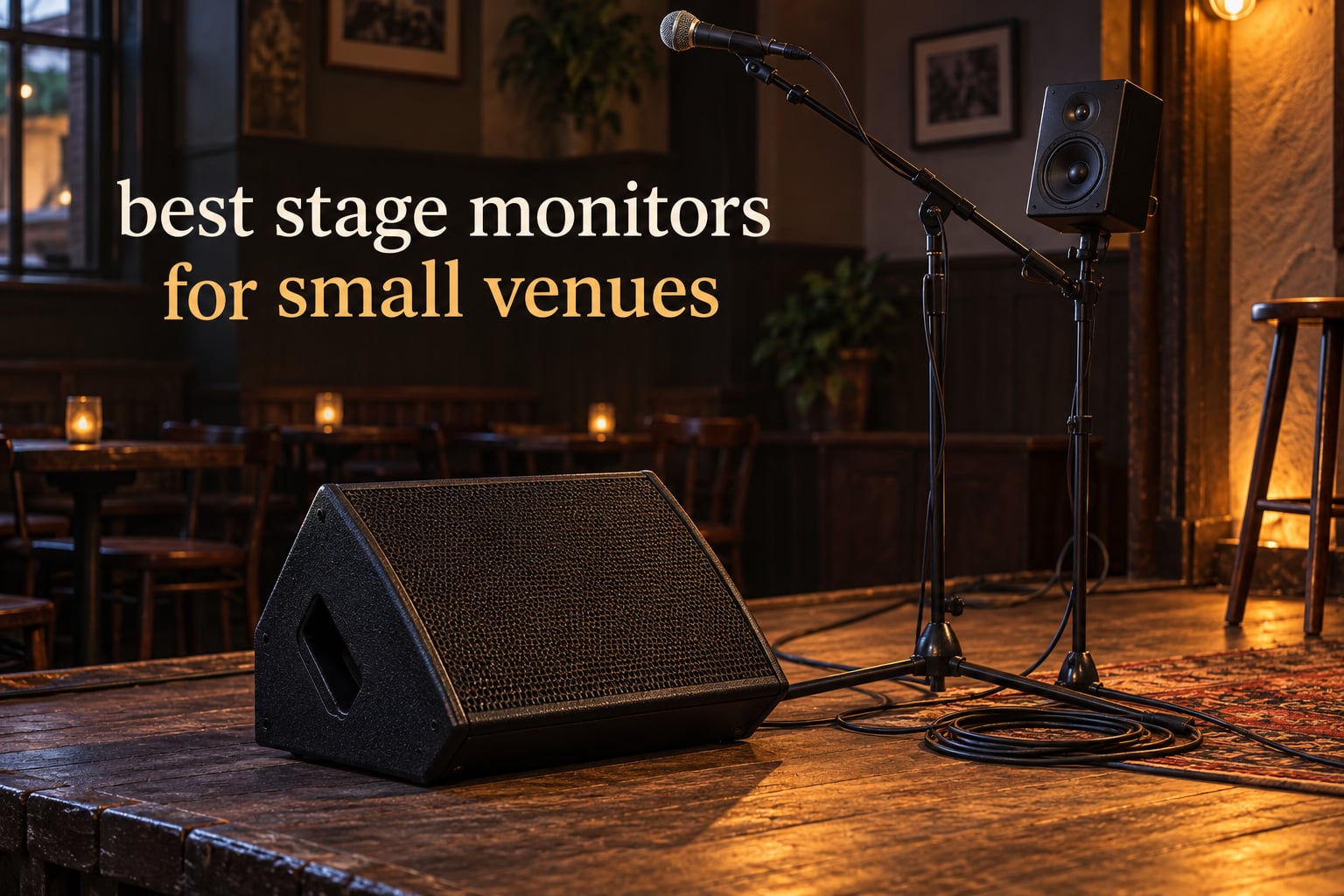
If you have ever finished a set in a bar or a church hall squinting at your own microphone because you could not hear a note of yourself, you already know the problem. The problem almost never turns out to be a lack of speaker power. It turns out to be stage volume: a drum kit, two guitar amplifiers, and a room with hard walls reflecting all of it back at the stage. A stage monitor, or floor wedge, is the small speaker on stage aimed back at the performer that solves that. This guide covers the best stage monitors for small venues, from compact mic-stand boxes to 12-inch powered wedges, with an honest look at what each one gives up.
We spent weeks comparing all ten cabinets below, and the pattern surprised us. The monitor that solved the most problems was not the loudest one. It was the smallest one we could carry, because in a small venue the constraint that shows up in practice is mixing, not output. That is why every review here carries a note on how many independent monitor mixes the cabinet needs and what your console has to feed it.
Before the picks, one piece of vocabulary. A stage monitor is fed from its own mix bus, usually a pre-fader aux send, so the performer’s level does not move when the front-of-house fader moves. A powered, or active, monitor has the amplifier built into the cabinet. A passive monitor is just a speaker and needs an external amp. A coaxial monitor puts the compression driver on the same axis as the woofer, so the mix stays consistent as the performer moves their head. We cover all three categories, because rooms under 150 people genuinely need different answers. If you are also shopping for smaller screens, our ultrawide monitor picks cover a different desk entirely.
Table of Contents
Top 3 Best Stage Monitors For Small Venues (October 2026)
Here is the short answer first, because most small-venue searches never need more than this.
Behringer Eurolive B205D – best overall. A 5.25-inch powered box at 7.05 pounds with two mic preamps and phantom power. It is the one we would put on a mic stand and leave there for a season.
Behringer Eurolive F1220D – best value wedge. A 250-watt 12-inch powered wedge with an adjustable feedback filter, which matters more in a reflective bar than raw output does.
Behringer EUROLIVE F1320D – premium band pick. A 300-watt 12-inch with a 1-inch compression driver, front-panel EQ and a sound processor. This is the one for a full four-piece in a room with a drum kit.


Behringer EUROLIVE F1320D
- 300W Class-D
- 12 inch woofer
- 1 inch compression driver
- sound processor
Two other cabinets earned their place in the full list. The Electro-Voice PXM-12MP is the best-sounding dedicated coaxial monitor here, and its 90 by 90 degree coverage is the reason a moving performer stays intelligible. The Samson RSXM10A is the most useful single-cabinet buy, because its front panel switch lets the same box serve as a front-of-house speaker and a monitor.
All 10 Stage Monitors Compared Side by Side
Every figure below is manufacturer-stated unless noted. We flag where owners report the number is optimistic, because that happens.
| Product | Specifications | Action |
|---|---|---|
| Behringer Eurolive B205D |
|
Check Latest Price |
 Mackie SRM150 Mackie SRM150 |
|
Check Latest Price |
| Behringer Eurolive F1220D |
|
Check Latest Price |
 Seismic Audio SA-10M Pair Seismic Audio SA-10M Pair |
|
Check Latest Price |
| Behringer EUROLIVE F1320D |
|
Check Latest Price |
 Sound Town METIS-10MPW Sound Town METIS-10MPW |
|
Check Latest Price |
 Samson RSXM10A Samson RSXM10A |
|
Check Latest Price |
 Grindhouse Speakers GH10M Grindhouse Speakers GH10M |
|
Check Latest Price |
 Seismic Audio SA-10MT-PW Pair Seismic Audio SA-10MT-PW Pair |
|
Check Latest Price |
 Electro-Voice PXM-12MP Electro-Voice PXM-12MP |
|
Check Latest Price |
1. Behringer Eurolive B205D – Best Overall for Small Venues
Behringer Eurolive B205D Active 150-Watt PA/Monitor Speaker System
150W Class-D
5.25 inch full-range driver
7.05 lbs
Phantom power
Pros
- Extremely light at 7.05 lbs
- one person can carry it
- Clean and loud enough for vocals and keyboard in small rooms
- Two mic preamps with phantom power plus an instrument input
- 3-band EQ and XLR link output onboard
Cons
- Only two inputs so a duet needs extra hardware
- Single full-range driver
- no real low bass
- EQ applies to the mixed signal not per input
Our verdict is simple: this is the monitor most small-venue buyers should end up with, and it is not close. The Eurolive B205D is 7.05 pounds and 8.66 by 11.42 by 7.28 inches, which means one person can carry it from the car to the stage in one trip without planning around it. That single fact decides more purchases than any spec sheet.
The sound is a 5.25-inch full-range neodymium driver pushed by 150 watts of Class-D amplification, and it is designed for the jobs small rooms actually have: vocal monitoring, keyboard monitoring, backing tracks, and a rehearsal room. Owners use it for all four and report clean output that holds up in a room with a guitar amp in it.
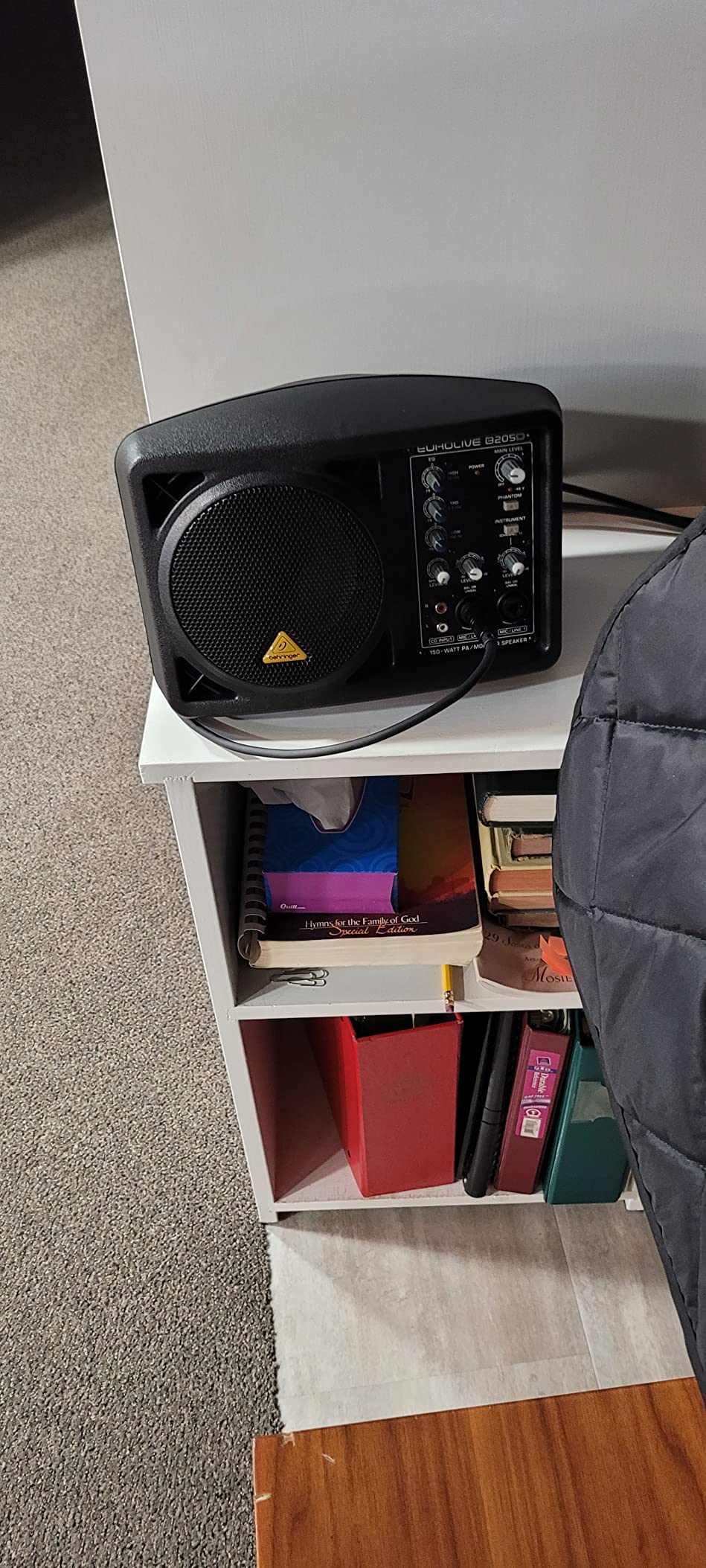
What makes it more than a tiny PA box is the onboard mixer. It has three channels with a 3-band EQ, two invisible mic preamps with phantom power for condenser microphones, and one instrument-ready input. Phantom power on a 7-pound speaker is the detail that surprises people most, because it means a large-diaphragm condenser vocal mic plugs straight in with no external supply.
There is a real limitation here. Two of the three channels are mic inputs, so a two-person setup with a singer and a guitarist cannot be handled without an external mixer or a small interface. If your act is a duo, read the powered pair in section 9 instead.
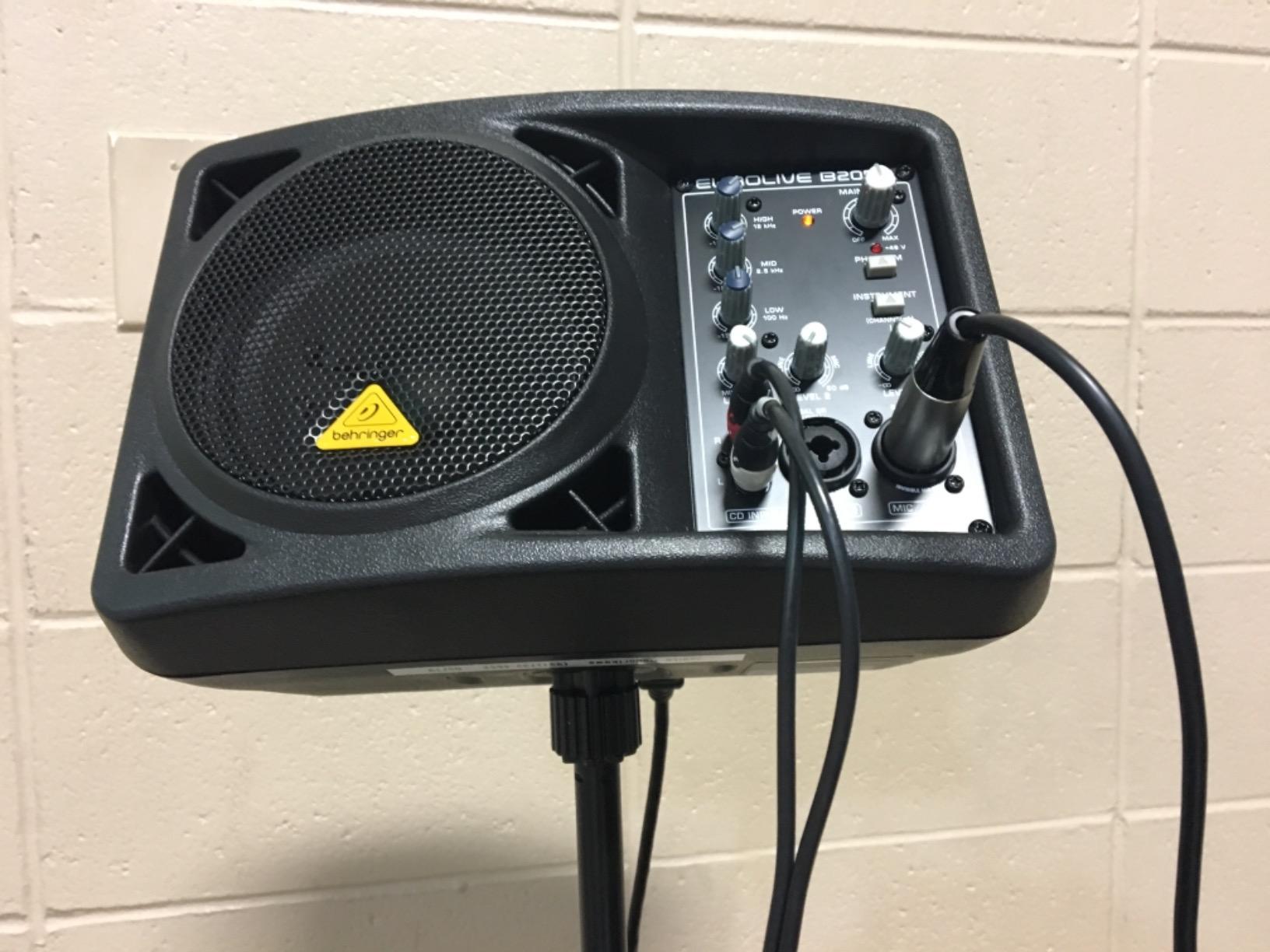
How the B205D fits a small room and a mix count?
Because it is a personal monitor rather than a full wedge, it takes one mix: the performer’s own. Point a single pre-fader aux send at the XLR input, mount it on a mic stand with the threaded socket, and set the level from the front. On a console like the Behringer XR18 that is a ten-second job.
It will not serve a main PA role. The single full-range driver means there is no genuine low end, so a bass player or a drummer will not find their footing in it. A reviewer noting the limited bass response is describing the design, not a fault.
Where the B205D falls short?
The 3-band EQ acts on the mixed signal rather than per input, so if you plug a vocal mic and a guitar in together you cannot shape them independently. That is fine for solo vocal work and frustrating for anything more.
A small number of owners also report channel or amplifier faults, and some had to tighten internal screws to stop vibration buzz. Buyers with no repair skills should factor that in, along with the fact that the mic-stand threading is plastic and can wear over years of regular use.
2. Mackie SRM150 – Best Compact Mic-Stand Vocal Monitor
Mackie SRM150 5.25-Inch Compact Active PA System, Black
150W Class-D
5.25 inch driver
7.6 lbs
3-year warranty
Pros
- Build quality feels solid with real physical knobs
- Loads without distorting for its size
- 48V phantom power supports condenser and PZM microphones
- Uses a standard IEC power cord
- Clean output for personal vocal monitoring
Cons
- No per-channel tone controls so it is weak as a small mixer
- Limited headroom and response
- unsuitable as a main PA
- Awkward upward angle on a mic stand
- Some owners report cut-outs after extended use
The Mackie SRM150 competes with the B205D directly and wins on build feel and warranty, not on features. It is the same basic idea: 150 watts of Class-D power into a 5.25-inch full-range neodymium driver, small enough to sit on a mic stand, at 7.6 pounds.
Two details put it ahead for some buyers. The signal-to-noise ratio is listed at 70 dB, and it takes XLR, quarter-inch TS and TRS jacks with a Hi-Z switch plus 48V phantom power, so a PZM contact mic works as well as a condenser. It also runs on a standard IEC power cord rather than an external wall wart, which matters when you are daisy-chaining power at a small venue.
The warranty is the quiet advantage: three years on electronics. Forum users treat warranty length as a tiebreaker, and short terms on budget gear are a common frustration in threads about hauling equipment to 50 shows a year.
Where the SRM150 fits?
This is a one-mix solution. A single aux send, a mic stand, and a singer who wants their own vocal. The frequency response is listed as 100Hz to 17.5kHz, which covers the vocal range with room to spare and nothing below the fundamental.
If you also need to cover a small room rather than one performer, this is not the tool. Owners are consistent that the limited headroom and modest bass make it unsuitable as a main PA, and adding a subwoofer is not a realistic answer at this size.
Where the SRM150 falls short?
There are no individual tone controls per channel, so it functions as a monitor, not as a mini mixer. If you were hoping to run a mic and a backing track through it with independent EQ, that is not what it does.
The mic-stand mounting angle is the other recurring complaint. Owners describe it as awkward and top-heavy, with the cabinet pointing upward rather than squarely at the performer’s ears. Several also report units cutting out with heavy hissing after extended use at gigs, so for someone running a regular show, the three-year warranty is doing real work.
3. Behringer Eurolive F1220D – Best Value 12-Inch Wedge
Behringer EUROLIVE F1220D Bi-Amped 250 Watt Monitor Speaker System with 12″ Woofer, 3″ Tweeter and Feedback Filter
250W Class-D
12 inch woofer,3 inch tweeter
23.6 lbs
8 ohm
Pros
- Strong clear low end from a single integrated Class-D amp
- Wide frequency bandwidth
- Adjustable feedback filter helps in reflective small rooms
- XLR and quarter-inch plus RCA and Speakon connectivity
- Integrated limiter protects the driver
Cons
- Heavier cabinet is awkward to reposition between sets
- Feedback filter needs careful adjustment
- Single-channel design limits independent mixes
When a room is too loud for a 5-inch box, this is the cabinet we would add next. The Eurolive F1220D is a 12-inch two-way powered wedge rated at 250 watts with a dedicated 3-inch tweeter, and at 23.6 pounds it is a genuine wedge rather than a stand-mounted personal monitor.
The reason it earns best value is the adjustable feedback filter. In a small room with brick, glass and a low ceiling, feedback is a matter of when, not if, and a filter you can dial in from the back panel buys you time during soundcheck. Buyers specifically single it out for controlling squeal in small rooms.
Connectivity is unusually generous for the class: XLR, quarter-inch TRS and TS, RCA, and SpeakON. That means you can feed it from anything, and a passive source or a line-level source both work without an adaptor.
The 8-ohm impedance and integrated limiter make it forgiving of a mediocre signal chain, which is common when the monitor is fed from a small console with a long cable run.
How the F1220D fits a small room?
Think of it as one full monitor position. A four-piece band in a room up to about 100 people can run one for the singer, one for the guitar amp player, and share a second for keys and bass. Each cabinet takes exactly one mix, so the count of mixes on your console is what limits the number of monitors you can use.
Owners report wide off-axis coverage that keeps the mix readable when a performer turns their head, which is the practical benefit of a two-way box over a coaxial one in a very tight room.
Where the F1220D falls short?
Weight is the honest drawback. At 23.6 pounds and 18 by 18 by 12.25 inches, repositioning it between sets takes two hands and a plan. If your load-in is one person and one trip, look at the compact boxes in sections 1 and 2.
It is also a single-channel design, so it accepts one mix only. And the feedback filter, while useful, needs careful adjustment: owners note that settings require care rather than being a set-and-forget control.
4. Seismic Audio SA-10M – Best Passive Matched Pair
Seismic Audio – Pair of Passive 10″ Wedge Style Floor Monitors – Studio, Stage, or Floor use – PA/DJ Speakers – Bar, Band, Karaoke, Church, Drummer use
Passive 10 inch two-way
100W RMS,200W peak
8 ohm
95 dB sensitivity
Pros
- Sold as a matched pair
- so you get two full monitor positions
- 10 inch two-way handling suits typical small-venue amplification
- Rugged 5/8 inch plywood front panel with carpet and metal grille
- 45Hz to 20kHz range at 95 dB sensitivity
- Recessed handles make transport between sets easier
Cons
- Passive only so an external amplifier is required
- Heavier pair than powered single monitors
- Average rating compared with the powered two-way options
This pair is chosen for a specific situation: you already own an amplifier, and you want two proper floor wedges for two performers without buying two powered cabinets. The Seismic Audio SA-10M set is two passive 10-inch two-way wedges, each with a 10-inch two-way woofer using a 40 oz magnet and a 2-inch voice coil, rated at 100 watts RMS and 200 watts peak at 8 ohms.
The build is the interesting part. The front panel is 5/8-inch plywood, wrapped in black carpet with black metal corners, a metal grille, and dual ports. Recessed handles are fitted, which matters more than it sounds when you are moving cabinets across a pub floor.
Sensitivity is listed at 95 dB with a range of 45Hz to 20kHz and a 4×8 piezo tweeter. That sensitivity figure is why the pair can be driven by a modest amp and still fill a small room; it is the number to look at on passive cabinets, not the peak wattage.
How the SA-10M pair fits?
It is a two-position solution. One wedge for the vocalist and one for the instrumentalist, each fed from its own aux send. Owners use them for small clubs, churches, weddings, karaoke and drum monitoring, which is a fair description of the small-venue market.
Because they are passive, the amp becomes part of the decision. Anything that delivers clean power at 8 ohms, or 4 ohms if it is stable into that load, will do. Keep the gain structure conservative and the limiting in the amp rather than in the cabinet.
Where the pair falls short?
The amplifier is not optional, and that is the whole cost argument. Add a two-channel amp, speaker cable, and you are spending more than a single powered wedge would have cost for one position, though the math flips in your favour at two positions.
The listed weight for the set is 22 pounds, so it is not a one-person carry for two cabinets at once. The warranty is one year, which is the shortest in this group, and the piezo tweeter gives you less high-frequency detail than the titanium and compression drivers in the powered cabinets.
5. Behringer EUROLIVE F1320D – Premium Band Monitor
Behringer EUROLIVE F1320D Active 300 Watt 2-Way Monitor Speaker System with 12″ Woofer, 1″ Compression Driver and Feedback Filter
300W Class-D
12 inch woofer,1 inch compression driver
33.1 lbs
Pros
- Purpose-built low-profile wedge rather than a PA box on its side
- Plenty of stage volume for a room of roughly 100 people
- Wide off-axis coverage that stays readable when the performer moves
- Front-facing EQ and gain controls plus a usable anti-feedback filter
- Strong and clear bass for indoor rooms
Cons
- Aggressive clipping at high volume with limited headroom
- Controls can be adjusted during a show
- Wood cabinet is heavy to lift
- Less effective outdoors
When a room has a full drum kit on it, the compact boxes stop being enough. The EUROLIVE F1320D is the band monitor: 300 watts of Class-D power into a 12-inch woofer paired with a 1-inch compression driver, and it is a purpose-built low-profile wedge rather than a PA cabinet tipped on its side.
That distinction matters more than it sounds. A wedge is shaped so the driver fires down the slope of the cabinet toward the performer’s ears, which keeps the coverage where it belongs on stage. The signal-to-noise ratio is listed at 94 dB and the frequency response at 80 Hz, so it will carry a guitar amp player without turning into noise.
Owners consistently describe it as having plenty of stage volume for a room of roughly 100 people, with wide off-axis coverage that keeps the mix readable when a performer shifts their head. The front-facing EQ and gain controls are on the panel the performer can actually see, which shortens soundcheck considerably.
Like the F1220D, it carries an adjustable feedback filter and an integrated limiter plus a sound processor. In a hard-walled bar, that filter is the difference between a usable wedge and a squealing one.
How the F1320D fits a band?
Budget one cabinet per position: one for the singer, one for the guitarist, one for the drummer, one for bass. A room under 150 people rarely needs more than that, and any spare positions can be a shared wedge on a stereo aux pair for the horns or keys.
The front-panel access is the underrated feature for a working band. Nobody wants to reach behind a wedge on a dark stage to find the high-pass, and this one puts the controls where the performer can see them.
Where the F1320D falls short?
At 33.1 pounds and 19.5 by 19.5 by 18 inches, this is a two-person lift. It is the heaviest single powered cabinet in the group, and load-in is where that shows up for anyone playing smaller rooms on a regular basis.
Owners also report aggressive clipping at high volume, with limited headroom for loud singers. If your vocalist pushes hard and sits close, the F1220D in section 3 is the gentler choice. It is also less effective outdoors, where the bass response does not carry the way it does indoors.
6. Sound Town METIS-10MPW – Budget Powered Wedge for Bars and Churches
Sound Town Powered DJ PA Stage Monitor Speaker 10” 300W with Compression Driver for Live Sound, Bar, Church (METIS-10MPW)
Powered 2-way 10 inch
300W integrated amp
1 inch titanium driver
Pros
- Thick full sound with plenty of output for rehearsal rooms and small bars
- Relatively light for a 10-inch powered wedge
- Onboard 3-band EQ plus XLR daisy-chain output
- Durable carpeted cabinet with metal grille and reinforced corners
- Customer service praised for resolving issues quickly
Cons
- Some owners report real output below the advertised wattage
- Occasional cabinets arrive inoperable or fail early
- New cabinets need time to dial in to avoid feedback
- Highest share of one-star reviews among the powered wedges here
The METIS-10MPW is a low-cost route to a genuine powered two-way wedge with a titanium compression driver, and for church halls and rehearsal rooms it does a lot for the money. It pairs a 10-inch woofer with a 1-inch titanium compression driver behind a 300-watt integrated amplifier, with a low-profile wedge enclosure at 12.6 by 19.1 by 10.8 inches.
The input section is better than the class usually manages: one XLR line input, one XLR line output for daisy chaining, a quarter-inch auxiliary input, and an eighth-inch MP3 input. Add onboard 3-band bass, mid and treble controls and you can cover a worship team or a bar gig with two of them without a separate mixer.
Physically it is built for the road: black carpet covering, a heavy-duty metal grille, reinforced metal corners, and a recessed carry handle.
How the METIS-10MPW fits?
It is a two-position answer: one cabinet for the vocalist, one for the band or the keyboard player, each on its own aux send. Owners use it for rehearsal rooms and small bars and report a thick, full sound for its size.
The XLR link output means you can also feed a second passive cabinet if the room is bigger than the box. That flexibility is what makes it a common sight in church installs.
Where the METIS-10MPW falls short?
Be cautious with the wattage figure. A recurring minority of owners report actual output well below the advertised 300 watts, and this cabinet has the highest share of one-star reviews among the powered wedges in the group, with cabinets arriving inoperable or failing inside the return window.
New cabinets also need time to dial in before they stop feeding back, which is normal for a wedge with a bright compression driver but a real shock for a first-time buyer. The warranty is one year, and the weight is not listed by the manufacturer, so budget carefully if you carry your own rig.
7. Samson RSXM10A – Best for One-Cabinet Versatility
Samson RSXM10A – 800W 2-Way Active Stage Monitor, Black
800W Class-D
10 inch coaxial with 1 inch tweeter
30 lbs
2-year warranty
Pros
- 800W Class-D output gives real headroom for loud stage volumes
- FOH and monitor selector switch lets one cabinet serve both roles
- XLR combo input and XLR link output make daisy-chaining simple
- All-wood cabinet with a compact coaxial footprint
- 2-year parts and labor warranty
Cons
- Heavy at 30 pounds for a compact two-way wedge
- Requires mains power so it is not suited to unplugged busking
- Fewer tone controls than the Behringer wedges with built-in EQ
The Samson RSXM10A solves a problem the other cabinets here do not: what happens when you have one speaker and need it in two places. Its front-panel FOH and monitor selector switch retunes the cabinet for a front-of-house role or a wedge role, which means a two-person act can carry one box and deploy it either way.
It is also the highest-output powered monitor in the group, with 800 watts of Class-D power into a 10-inch coaxial driver with a 1-inch tweeter. The frequency response is listed at 55 Hz, and the all-wood cabinet is 16 by 17.25 by 17 inches with a 1-3/8-inch pole mount receptacle.
Connectivity is straightforward: an XLR and quarter-inch combo input, plus an XLR link output for daisy chaining. No fuss, no menu.
How the RSXM10A fits?
It is a single-position monitor with a lot of headroom, which is exactly what a band playing at stage volume needs when the guitar amp and the kick drum are the reason the monitor exists. The extra power is wasted in a quiet room and welcome in a loud one.
Because it is coaxial rather than a separated two-way, the coverage stays consistent as the performer moves, which is useful on a shallow stage where a conventional box would need careful aiming.
Where the RSXM10A falls short?
It is 30 pounds, so the one-person load-in advantage of the compact boxes is gone. The pole mount receptacle helps with positioning, but the cabinet is not light enough to move casually between sets.
It also needs mains power, which rules it out for unplugged busking, and it has fewer tone controls than the Behringer wedges. Owners pick it for power and versatility rather than for built-in EQ, so if your mix needs shaping at the wedge, this is not the cabinet.
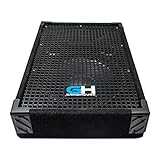
8. Grindhouse Speakers GH10M – Lowest-Cost Route to a Working Wedge
Grindhouse Speakers – GH10M – 10 Inch Passive Wedge Floor / Stage Monitor 300 Watts RMS – PA/DJ Stage, Studio, Live Sound 10 Inch Monitor
Passive 10 inch wedge
300W RMS,600W peak
8 ohm
Single or pair
Pros
- Lowest entry cost among the passive cabinets here so paired monitors stay affordable
- Lightweight and easy to move between small-club sets
- 300W RMS handling gives headroom on a typical small amp
- Clear sound that lets acoustic performers hear themselves in a noisy room
- Straightforward hookup via quarter-inch TS or speaker wire terminals
Cons
- Passive only
- so an external amplifier is required
- Can distort or peak at higher levels when driven hard
- Limited on-board tone shaping
- Higher share of three-star reviews than the alternatives
Some venues already have an amp in a rack and a pair of speaker cables, and for them the Grindhouse GH10M is the efficient choice. It is a passive 10-inch wedge rated at 300 watts RMS and 600 watts peak per cabinet at 8 ohms, and it is available as a single cabinet or as a pair.
The power-handling figure is the useful part. Three hundred watts RMS is enough headroom that a typical small amp will not be the limiting factor, and the cabinet is 13 by 19 by 12 inches, so it takes a normal wedge position on a small stage.
Owners use it for acoustic trios and four-piece bands in small clubs, and report clear sound that lets acoustic performers hear themselves in a noisy room. That is a real result in a pub with a conversation-level noise floor.
How the GH10M fits?
It is a straightforward wedge with no onboard processing. One cabinet per mix position, wired with quarter-inch TS plugs or speaker wire terminals, powered from whatever amp you already have. Keep the amp gain conservative and the distortion complaints largely disappear.
It is worth buying the pair rather than the single. Matching two cabinets of the same model also means the two monitor mixes behave the same way, which removes a variable from a small stage.
Where the GH10M falls short?
Passive only, so the amplifier question from section 4 applies in full. There is no on-board tone shaping at all, which means every EQ decision happens at the console, and on a two-aux console that can be limiting.
The most repeated limitation is distortion when the cabinet is driven hard, usually from pushing the amp too far. Three-star reviews also make up a larger share of the ratings here than with the alternatives, so expect some inconsistency between cabinets. The manufacturer does not list a weight, which is worth asking about before you commit to carrying it yourself.
9. Seismic Audio SA-10MT-PW Pair – Best Powered Matched Pair
Seismic Audio – SA-10MT-PW-Pair – Pair of Powered 2-Way 10″ Floor / Stage Monitor Wedge Style with Titanium Horns
Powered pair
250W per cabinet
10 inch with titanium horn
8 ohm
Pros
- Two powered monitors in one purchase
- each with its own 250W amplifier and 3-band EQ
- Titanium horn tweeters deliver clear highs and rich bass
- XLR combo
- quarter-inch
- SpeakON and 3.5mm inputs
- Switchable 110V and 220V power selection
- Full metal grille and carpeted cabinet survive transport
Cons
- Recessed handles can break off during carry
- Some cabinets show tweeter distortion at higher volume
- 70 pounds for the pair so it takes two trips
- Amp plate bolts on the back may loosen with vibration
Two performers who both need real monitor level is the case the single-cabinet options cannot serve, and this is the fix. The SA-10MT-PW pair ships two powered two-way 10-inch wedge floor monitors, each with its own 250-watt amplifier, a 3-band EQ, and a gain control.
The titanium horn tweeters are the reason buyers describe a dramatic improvement over smaller 8-inch or budget monitors, with clear highs and rich bass from a 10-inch woofer. Each cabinet is 22 by 19 by 17 inches and the impedance is 8 ohms.
The I/O is unusually good for a paired product: XLR combo, quarter-inch, SpeakON and 3.5mm inputs per cabinet, plus a power select switch for 110V or 220V. That last detail is not cosmetic if you play across borders. Both cabinets have full metal grilles and recessed handles.
How the pair fits a two-performer act?
Assign one cabinet to each aux send and you have a proper two-position wedge rig with no external amp, no speaker cable runs, and no mixer between the console and the stage. For a duo playing bars and restaurants, that is the whole argument.
Owners regularly report that the pair compares well against larger and more expensive cabinets, and the 3-band EQ on each box gives you some mix shaping without touching the console.
Where the pair falls short?
Weight is the dominant problem. At 70 pounds for the pair, this is two trips and likely two people, which undercuts the point of a paired product for anyone loading in alone.
Recessed handles breaking off during carry is the most reported mechanical problem, so treat the handles as consumable. Some cabinets also show tweeter distortion at higher volume, and the amp plate bolts on the back can loosen with vibration and need replacing. It also takes time to dial in: too much gain causes distortion quickly.
10. Electro-Voice PXM-12MP – Best Coaxial Clarity Per Watt
Electro-Voice Pxm 12MP 12 700W Powered Coaxial Monitor (Black)
700W Class-D
12 inch coaxial,90 x 90 degree coverage
29.8 lbs
3-year warranty
Pros
- Best rating in the group with 88 percent five-star reviews
- 12 inch coaxial driver with consistent 90 x 90 degree coverage across the stage
- 55 degree wedge angle lets performers adjust distance without losing intelligibility
- Deep DSP with four EQ presets
- parametric mids
- low-cut filters and a tunable feedback notch
- 700W Class-D amplifier plays consistently at the edge of its ratings
- 3-year warranty and optional subwoofer integration
Cons
- Most expensive cabinet in the group
- Substantial weight for a portable monitor
- Requires mains power so it is not usable unplugged
The PXM-12MP is the most capable dedicated coaxial monitor in this list, and the design choice is the entire reason to consider it. A 12-inch coaxial driver with a 1.75-inch horn produces a solid, consistent 90 by 90 degree coverage pattern, which means the mix stays clear across the whole stage rather than only where the cabinet happens to be aimed.
Users on the Gearspace live sound board point to this model for dedicated monitor use, specifically because of the low profile and the floor-monitor voicing, even when a louder alternative exists. That is the correct comparison to make: it is not the loudest cabinet here, it is the one that stays intelligible.
The 55 degree monitoring angle is the feature people do not expect. It lets a performer stand close to the wedge or step back toward the audience without losing intelligibility, which on a shallow small-venue stage is worth more than extra watts.
What the DSP actually gives you?
The processing is unusually deep for a wedge: four EQ presets, high and low shelving filters, parametric midrange EQs, adjustable low-cut filters, a tunable feedback notch filter, and recallable user settings. The feedback notch is the one to learn first, because it is a frequency-specific problem solver rather than a blanket cut.
There is also an integrated three-channel mixer with two XLR and quarter-inch combination connectors and a stereo RCA input, plus adjustable subwoofer matching low-pass filters so you can build a compact three-way main PA with a dedicated subwoofer if the room ever needs it. The amplifier is 700 watts of Class-D with system protection and limiting, and the warranty is three years.
Where the PXM-12MP falls short?
Cost is the honest answer. It is the most expensive cabinet in the group by a wide margin, and that price can exceed the entire monitor budget of a very small venue. We would not call it the wrong choice for a small room; we would call it a hard stretch for one.
It is 29.8 pounds at 17.75 inches square, so it is a substantial lift, and it needs mains power, which rules it out for anything unplugged. If the budget is the binding constraint, the F1320D or the F1220D give you more cabinet for the money.
How Many Stage Monitors Does a Small Venue Actually Need?
Start with the number of performers, not the number of watts. Every wedge you add is one independent mix, and independent mixes come from aux sends on your console. A four-piece band needs a singer, a guitarist, a drummer and a bassist, which is four mixes whether the room holds 50 people or 500.
Under 50 capacity, a solo performer or duo, one or two compact powered boxes are enough. The stage volume problem is usually solved by turning down, not by adding monitors. A room this size is often better served by in-ear monitors, which we cover further down.
From 50 to 150 capacity, a typical pub, bar, restaurant or small club, budget two to four powered wedges. A three or four-piece with a drum kit will want one 12-inch wedge per position. The wattage range that covers this is roughly 250 to 500 watts per cabinet for most rooms, and we say that with the manufacturer-figure caveat below.
From 150 to 300 capacity, or any room with a loud stage volume, one full wedge per performer and a shared pair for horns, keys or a second guitarist. This is where a coaxial cabinet starts earning its cost, because stage depth and head movement make coverage consistency more valuable than peak output.
The one thing that trips people up is the console. We looked at the mix-count problem in detail below, because it is the actual purchasing blocker in most small-venue threads we read.
Powered vs Passive Monitors: Which One for a Small Room?
For a small venue, powered wins, and the reason is arithmetic rather than sound quality. A passive cabinet is only half a purchase. You also need an amplifier, speaker cable, and somewhere to put the amp, and the total for a passive setup often exceeds a powered wedge when you only need one position.
The math flips at two positions, which is exactly where the two passive picks in this list make sense. A matched passive pair plus a two-channel amp serves two performers for less than two powered cabinets, and it also gives you a spare amp channel later.
Powered cabinets also protect themselves. Both Behringer wedges and the Electro-Voice have integrated limiting, which matters when a loud singer pushes a monitor that is already at its limit. A passive cabinet relies on the amp, and a cheap amp may not deliver that.
Two details favour passive in specific cases. If you already own a good amp and quality speaker cable, the incremental cost of passive cabinets is low. And passive cabinets cannot fail in the electronics, which some touring players prefer. Against that, a passive wedge with no amp is simply a box that makes no sound.
What Woofer Size Do I Need – 8, 10, 12 or 15 Inch?
Five and a half inches, like the B205D and the SRM150, is a personal monitor. It sits on a mic stand or a short stand and is aimed at one performer. Excellent for vocals, keys and solo work, and useless for a drummer or bassist who needs low end.
Ten inches is the small-venue default. The Sound Town, the Samson, the Seismic powered pair and both passive 10-inch options sit here. A 10-inch two-way with a compression driver gives you a usable vocal range plus some low end, and it is the size most pub stages can physically fit.
Twelve inches is the band wedge. The F1220D and the F1320D both use 12-inch woofers, and this is the size that projects enough low end to be heard over a drum kit. Twelve inches is still reasonably compact, and 18 inches wide is about the limit of what fits a small riser without stealing foot position.
Fifteen inches is not on this list for a reason. It exists in the category, and it is a legitimate choice for a drummer, but at that size you are buying a cabinet that needs a floor position and a plan. In a room under 150 people it is usually a waste of money and a load-in problem, and you get better results from a 12-inch wedge plus a lower monitor level on the drum mic.
The common mistake is assuming a bigger woofer is always better. A larger driver reproduces lower frequencies, but if the stage volume problem is vocal clarity, a 12-inch with a good compression driver beats a 15-inch with a mediocre one.
Coaxial vs Conventional Two-Way Monitors Explained Simply
A conventional two-way puts the compression driver above the woofer, with the crossover spreading the frequencies apart. It is louder across a wide area and it is the traditional choice, but the coverage depends heavily on where the cabinet is aimed. Turn your head too far and the high end falls off a cliff.
A coaxial puts the compression driver on the same acoustic axis as the woofer, concentrically. The result is a narrower but very consistent coverage pattern, which in a wedge means the mix stays the same whether the performer leans in or steps back. That is the 90 by 90 degree figure on the Electro-Voice PXM-12MP.
For a small venue, our view is that coaxial is worth the premium when the stage is shallow and performers move. If your performers stand still at a marked spot and the wedge is aimed properly, a conventional two-way gives you more output and more low end for the money.
Forum consensus regularly reports that the coaxial monitors get preferred for dedicated monitor duty over louder conventional cabinets, precisely because the low profile and the consistent coverage matter more than peak SPL on a small stage.
Do Not Rank Stage Monitors by Wattage?
Watts are the least reliable number in this category, and we would rather say so than rank by it. Manufacturer wattage is usually a peak or maximum figure, not sustained output, and the same number means different things across manufacturers. A 300-watt label on one cabinet and a 300-watt label on another do not describe comparable headroom.
You can see it in the owner feedback here. Buyers of the Sound Town METIS-10MPW report actual output well below the advertised 300 watts, while owners of the Samson RSXM10A, labelled at 800 watts, describe the real-world headroom as the reason they bought it. Neither claim is proof of anything except that the labels are not comparable.
Three numbers are worth more. Sensitivity, in dB, tells you how efficiently a passive cabinet converts amplifier power into sound, and 95 dB is a good figure. Peak SPL, measured at a stated distance, tells you how loud the cabinet can actually go. And frequency response tells you the low end you can expect before you buy.
Every specification in this guide is manufacturer-stated. We have not independently measured any of it. Where owners contradict the figure, we have said so rather than repeating the number as fact.
How Many Monitor Mixes Can Your Console Give You?
This is the question that actually stops purchases, and it is raised constantly in live sound forums and answered in almost no buying guide. You can own ten monitors and use two of them if your console only has two mix outputs.
Digital consoles for small rooms vary enormously. A Behringer XR18 gives you 16 aux outputs, which is more monitor mixes than any small-venue band will use. A Midas M32 gives you 16 aux sends as well, plus matrix outputs, so mixes are not the constraint. A Mackie DL32S gives you 16 aux sends too.
The smaller mixers are where the problem lives. A small analogue mixer with four aux sends supports four monitor positions, and if you need stereo, it supports two. That is the real limit for a bar gig using a compact mixer, and it is worth counting before you buy anything.
Use pre-fader sends for monitor mixes wherever possible. A post-fader send means the performer’s level drops when you pull the front-of-house fader down, and they will ask you to turn it back up, which turns into a volume argument with the room.
One more constraint worth mentioning: if your console has two aux sends and a four-piece band, the honest answers are to split mixes, to go in-ear, or to change consoles. Speakers are almost never the bottleneck in that situation. A small-venue buyer on a Behringer XR18 plus a wireless in-ear rack running main left and right only is a realistic alternative signal chain for a room this size.
Wedge, Sidefill, or In-Ear Monitors in a Small Room
A wedge points up at one performer. A sidefill sits at the front edge of the stage and points along the stage lip, which serves several performers at once and is more of a front-of-house support tool than a monitor. In-ear monitors put the mix directly in the performer’s ears with no cabinet on stage at all.
For a room under 100 people, the strongest argument for in-ear monitors is that stage volume is the actual problem. Users on r/livesound argue consistently that wedges should be eliminated in small rooms, because removing the wedge lets the band turn down and fixes the underlying issue rather than the symptom.
The obstacle is social, not technical. A touring player we read about tried in-ear monitors and rejected them because the rest of the band would not adopt them. That is a harder problem to solve than picking a driver size, and it is the single most common reason in-ear systems get abandoned.
A sensible middle path for a small venue is one wedge for the vocalist, who is usually the person most exposed to hearing damage, and in-ear for everyone else. Or one shared stereo wedge on a single aux pair, which halves the mix count you need at the cost of individual control.
Whatever you choose, do not add monitors without counting mixes first.
How to Place a Floor Wedge and Kill Feedback?
Feedback in a small venue is a placement problem before it is an equipment problem. Six steps fix most of it.
1. Count your aux sends and map them. Write down which mix each wedge gets before you unbox anything. If your console has four sends, you have four positions, whatever you own.
2. Start with the gain structure conservative. Set the console send low and bring the cabinet’s own gain up only as far as it needs. Most feedback comes from too much level at one point in the chain rather than from the wrong cabinet.
3. Aim the wedge at the microphone’s rejection zone, not at the singer. Your ears should sit inside the useful coverage. On a 55 degree wedge such as the PXM-12MP this is forgiving, which is exactly the point of that angle.
4. Keep the mic behind the wedge relative to the audience. The classic rule: the monitor points at the performer, and the microphone’s least sensitive side points back at the wedge. Move the mic stand, not the cabinet, if the geometry is wrong.
5. Notch the offending frequency rather than cutting the highs. Find the frequency that squeals, then cut three to six dB with a narrow Q. The Behringer wedges and the Electro-Voice all have a feedback filter for exactly this, and a narrow notch fixes a specific problem without dulling the whole mix.
6. Only then move the wedge. Changing position is the last step, not the first, because a notch you can tune is repeatable and a wedge position at the venue is not.
Two extras for hard rooms. A low-cut filter on the monitor mix at around 100 Hz reduces how much low end spills back toward the mic. And in a room with brick, glass and a low ceiling, treat feedback as a given and rehearse the soundcheck accordingly rather than assuming the room will behave.
Pre-Purchase Checklist for Small-Venue Stage Monitors
Before you commit, run through these seven checks.
Aux sends. Confirm your console has one output per position you intend to fill. This is the number one reason a good monitor goes unused.
Power at the stage. Every powered cabinet here needs mains. Check how many outlets the stage actually has and whether the venue supplies them, since that is a real constraint in a lot of small rooms.
Cables. Powered cabinets take XLR from the console. Passive cabinets need speaker cable, and quarter-inch TS plugs of any quality work on both the Seismic and the Grindhouse. Bring spares.
Stage depth. Measure how deep the stage is. A 19-inch wide cabinet needs room in front of the performer, and a room with a drum kit on it may have less than you think.
Load-in weight. Check the weight of the full rig, not just the monitor. A single 33-pound wedge can be the difference between a comfortable load-in and a strained one.
Model generation. Popular ranges get refreshed, and a listing for an older generation can carry specs and features that the current model does not have. Confirm the model number on the back panel and check the manufacturer page for the current generation before you rely on any specification in a listing.
Warranty. Yamaha’s seven years is treated as the category benchmark in forum threads, with the three-year terms on the Mackie and Electro-Voice a reasonable middle. One-year terms on budget imports are a deal breaker for anyone who plays regularly, because a failed cabinet mid-tour is your problem.
Two smaller items worth checking: whether the cabinet has a mic-stand or pole socket if you plan to elevate it, and whether the back-panel controls face the performer or the wall. The Behringer wedges put the EQ on the front, which saves real time on a dark stage.
Frequently Asked Questions
What are the best monitors for small spaces?
For a solo performer or duo in a room under 100 people, a compact powered monitor on a mic stand is the right answer. The Behringer Eurolive B205D and the Mackie SRM150 both use a 5.25 inch full-range driver, weigh about 7 pounds, and take one mix. For a band with a drum kit, step up to a powered 12 inch wedge such as the Behringer Eurolive F1220D or F1320D, one per performer.
What is the best monitor for a stage?
The best monitor for a stage in a small venue is a powered 12 inch two-way wedge, one per performer. The Behringer EUROLIVE F1320D gives you 300 watts into a 12 inch woofer and 1 inch compression driver, with an adjustable feedback filter and front-panel EQ. The lower-cost Behringer Eurolive F1220D does the same job with a 12 inch woofer and 3 inch tweeter at 250 watts, which is usually the better starting point.
What sound system is best for small events?
For a small event, build around the performer rather than the room. One powered wedge per performer, a console with at least as many aux sends as wedges, and a front-of-house pair sized to the room. In rooms under 100 people, replacing some wedges with wireless in-ear monitors often solves the problem faster than adding speakers, because stage volume is what limits a small room.
What is the best sound system for small spaces?
A small-space system should be small on paper too. Powered monitors beat passive ones for a single position because a passive cabinet needs an amplifier and cable on top of the cabinet cost. Count your console aux sends before choosing monitors, and buy wedges to match the number of performers rather than the size of the room. In very small rooms, in-ear monitors solve stage volume better than any speaker choice.
How many watts should a stage monitor be?
For vocal-only monitoring in a bar or club up to 150 people, roughly 200 to 300 watts per cabinet covers it comfortably. A full band at stage volume with a drum kit wants more, around 300 to 500 watts per position. Do not treat these as a ranking rule, because manufacturer wattage figures are not measured the same way across brands, and a 95 dB sensitivity rating on a passive cabinet tells you more than a peak number.
How do I stop a stage monitor from feeding back?
Start with placement, not EQ. Set the console send low, aim the wedge at the performer rather than across the stage, and keep the microphone behind the wedge from the audience. Then find the frequency that squeals and cut three to six dB with a narrow Q rather than trimming the high end. Monitors with a built-in feedback filter, such as the Behringer F1220D and F1320D or the Electro-Voice PXM-12MP, save time here.
Should I use a wedge monitor or in-ear monitors?
Use in-ear monitors when the room is under about 100 people and stage volume is the real problem, because removing the wedge lets the band turn down. Use wedges when performers move around, when the act is not wearing in-ears consistently, or when you want each player to control their own mix. A common compromise in a small venue is one wedge for the vocalist and in-ears for the rest of the band.
What size stage monitor do I need – 8, 10, 12 or 15 inch?
Five to six inch units are personal monitors for vocals and keys. Ten inch is the small-venue default and fits most pub stages. Twelve inch is the band wedge and the size that projects enough low end to be heard over a drum kit. Fifteen inch exists for drummers but is heavy and usually unnecessary in a room under 150 people, where a 12 inch wedge plus a lower drum mic level works better.
Bottom Line: Which Stage Monitor Should You Buy?
For a solo performer or a duo in a room under 100 people, the best stage monitors for small venues are the compact ones. The Behringer Eurolive B205D is our pick: 7.05 pounds, two mic preamps with phantom power, three-band EQ, and an XLR link output, all in a cabinet that has been in continuous production since 2010.
For a band in a pub or small club, the Behringer Eurolive F1220D is the value choice and the EUROLIVE F1320D is the one to buy if the stage volume is real. Both give you a 12-inch wedge, both have a feedback filter, and the F1320D adds the compression driver, the front-panel EQ and the headroom for a drum kit.
Buy a matched pair only when two performers genuinely need their own mix, and check your aux send count before anything else. If you want the best-sounding dedicated coaxial monitor and the budget stretches, the Electro-Voice PXM-12MP is the most intelligent box here, and its 90 by 90 degree coverage is the reason it stays intelligible on a stage where people move. All of this ranking is current as of 2026, and it is worth re-checking model generations before you buy, because the popular ranges in this category get refreshed.